Commercial Water Treatment in Surat: The Complete Guide for Hotels, Hospitals & Industries (2026)
An engineering guide to commercial water treatment in Surat, covering commercial RO plants, industrial water softeners, media filtration, and GIDC industrial water standards.
Quick Answer: What Is Commercial Water Treatment in Surat?
Commercial water treatment in Surat refers to engineered, high-volume purification systems—such as commercial reverse osmosis (RO) plants (100 to 10,000+ LPH), multi-tank industrial water softeners, and automatic sand/carbon filtration—designed to treat high-TDS groundwater and municipal blends for businesses, institutions, and factories.
Whether you operate a 100-room hotel on Dumas Road, a healthcare hospital in Vesu, a textile dyeing facility in Sachin GIDC, or a commercial kitchen in Adajan, commercial water treatment prevents mineral scaling, protects capital equipment, ensures health compliance, and eliminates costly plumbing repairs.
Why Surat Businesses Require Engineered Commercial Water Treatment
Surat is one of India's fastest-growing commercial and industrial engines, driven by textiles, diamonds, petrochemicals, hospitality, and healthcare. However, the city faces distinct geological water challenges due to its coastal position along the Arabian Sea and the Tapi River basin.
Depending on where your commercial facility is located, raw borewell water can fluctuate dramatically:
- Coastal Salinity & High TDS (Hazira, Dumas Road, Piplod): Groundwater TDS frequently surges between 1,200 and 3,500+ ppm due to seawater intrusion, requiring high-pressure brackish water RO membranes.
- Extreme Mineral Hardness (Sachin GIDC, Pandesara, Katargam): Borewell water often carries 400 to 900+ ppm of dissolved calcium and magnesium, causing rapid scale buildup in industrial boilers, cooling towers, and commercial laundry equipment.
- Variable Municipal Blending: Even commercial buildings receiving Surat Municipal Corporation (SMC) water frequently blend it with underground borewell supply during peak demand hours, causing unpredictable hardness fluctuations.
For an in-depth geographic breakdown of groundwater parameters across the city, review our Surat Borewell Water Hardness & TDS Guide.
Core Commercial Water Treatment Technologies
Commercial facilities cannot rely on standard domestic purifiers. Industrial-grade hardware requires continuous-duty pumps, automatic multi-port control valves, skid-mounted frames, and PLC automation. The primary systems include:
1. Commercial RO Plants (100–10,000 LPH)
Semi-permeable thin-film composite (TFC) membranes remove up to 98% of dissolved inorganic solids (TDS), heavy metals, and salinity. Engineered with stainless steel high-pressure pumps and automated flush cycles to handle feed water up to 10,000 TDS.
Explore Commercial RO Specifications →2. Commercial Water Softeners (Duplex/Triplex)
Ion-exchange resin vessels exchange scaling calcium and magnesium ions for sodium ions. For 24/7 commercial operations, duplex or multi-tank setups ensure uninterrupted soft-water supply while one vessel regenerates.
View Industrial Softener Range →3. Industrial Sand & Carbon Media Filters
Multi-grade silica sand filters trap suspended silt, clay, and turbidity down to 20 microns. Downstream activated carbon filters remove chlorine, organic compounds, color, and odor, protecting expensive RO membranes and boiler tubes.
4. Hydro-Pneumatic Pressure Booster Skids
Multi-pump variable frequency drive (VFD) booster skids maintain consistent water pressure across high-rise commercial buildings, hotels, and industrial process lines while reducing electrical power consumption by up to 40%.
Explore VFD Pressure Booster Pumps →Sector-Specific Commercial Water Requirements in Surat
Different commercial operations require vastly different water specifications. A single generic setup will fail if not matched to your facility's operational workflow:
| Commercial Sector | Primary Water Challenges | Recommended Commercial Solution | Key Business Benefits |
|---|---|---|---|
| Hotels & Hospitality | Scale on luxury bathroom fittings, ruined commercial laundry linen, high geyser maintenance | Whole-building Duplex Softener + 500–2,000 LPH Commercial RO for kitchen/drinking | Zero scale on chrome fittings, soft towels, 50% soap savings in laundry |
| Hospitals & Clinics | Dialysis feed water standards, autoclave sterilization scaling, pathogen control | Two-pass Commercial RO with UV post-treatment + central softening | NABH compliance, zero scaling in autoclaves and central sterilization |
| Textile & Dyeing Mills (Sachin / Pandesara) | Boiler tube explosion risk from scale, dye shade variation from hardness minerals | High-volume Multi-port Softeners (10–50 m³/hr) + Sand Pre-filtration | Zero boiler scaling, reduced fuel consumption, consistent dyeing batch color |
| Diamond & Jewelry Units | Mineral residues on polished stones, laser cutting cooling water scaling | Precision Commercial RO (250–1,000 LPH) with low conductivity output | Spot-free stone cleaning, protected laser cutting heads |
| Commercial Laundries | Excessive detergent consumption, stiff gray linen, boiler heating element burnout | Continuous-Duty Automatic Softener with digital regeneration control | 40% reduction in chemical spend, extended linen life |
How to Size a Commercial Water Treatment System in Surat
One of the most costly mistakes Surat business owners make is undersizing a system based on price or oversizing without planning for adequate feed supply and drain infrastructure.
To determine the correct commercial RO or softening capacity:
- Calculate Total Daily Consumption (Litres/Day): Determine total water consumed across kitchens, guest rooms, boilers, cooling towers, and drinking stations during peak operating days.
- Define Operating Window: Most commercial RO plants should operate between 12 and 18 hours per day to leave adequate buffer for maintenance, automated membrane flushes, and regeneration.
- Calculate Required Hourly Flow (LPH): Divide your daily treated-water requirement by operating hours. For instance, a 6,000-litre daily requirement over a 12-hour shift requires a minimum 500 LPH Commercial RO Plant.
- Test Feed Water Hardness & TDS: Raw water quality determines the recovery ratio (typically 60%–75% for RO) and the resin volume needed for softeners to prevent regenerating multiple times per day.
Operating Costs: What to Plan For
Purchasing the hardware is only one component of the lifecycle investment. A dependable commercial water treatment supplier will provide transparent projections on:
- Power Consumption: High-pressure vertical multistage pumps (e.g. CRI, Grundfos, or CNP) consume electricity relative to system pressure and flow.
- Regeneration Salt: Industrial softeners require high-purity refined salt for periodic brine regeneration. Sizing the resin bed properly reduces overall annual salt consumption.
- Membrane & Media Lifespan: High-quality TFC membranes last 2.5 to 4 years when protected by automated backwash sand and carbon filters. Without pre-treatment, membranes can foul within 6 months.
- Local Service & AMC Support: Routine filter cartridge changes, conductivity calibration, and antiscalant dosing inspections require dependable local technicians based in Surat.
Frequently Asked Questions About Commercial Water Treatment in Surat
What is the difference between a commercial and domestic RO plant?
A domestic RO produces 12 to 25 litres per hour for drinking purposes. A commercial RO produces between 100 and 10,000+ LPH using high-pressure industrial pumps, PLC automation, stainless steel skids, and heavy-duty 4040 or 8040 industrial membranes.
Do we need a water softener or an RO plant for commercial use?
It depends on the application. A commercial water softener removes hardness minerals (calcium and magnesium) to stop scaling in boilers, laundry, and plumbing lines. An RO plant removes dissolved salts (TDS) and is required when water is used for drinking, food preparation, pharmaceutical sterilization, or precision manufacturing.
Can Springwell Water Tech handle high-TDS borewell water in Hazira and Dumas?
Yes. Our commercial RO systems are engineered to handle high-salinity borewell feed water up to 10,000 TDS with specialized antiscalant dosing and brackish-water membrane configurations.
How fast can an on-site commercial site evaluation be scheduled in Surat?
Our engineering team is located on VIP Road, Vesu. We conduct physical on-site water testing and site inspections across Surat, Sachin, Hazira, and surrounding industrial zones within 24 to 48 hours.
Plan Your Commercial Water Treatment Solution with Springwell
Don't guess your commercial capacity or risk costly equipment failure from mineral scaling. Discuss your water quality analysis and daily volume requirements with Surat's experienced water treatment engineers.
Vimal Sutariya
Vimal Sutariya has over 12 years of hands-on field experience designing and installing water softening plants, commercial RO systems, and booster pumps across Surat, Hazira, Sachin GIDC, and South Gujarat.
Planning a Commercial RO System for Your Business?
Discuss your water quality, daily demand, and application requirements with Springwell Water Tech to identify a suitable water treatment solution tailored to your facility.
Related Water Treatment Guides
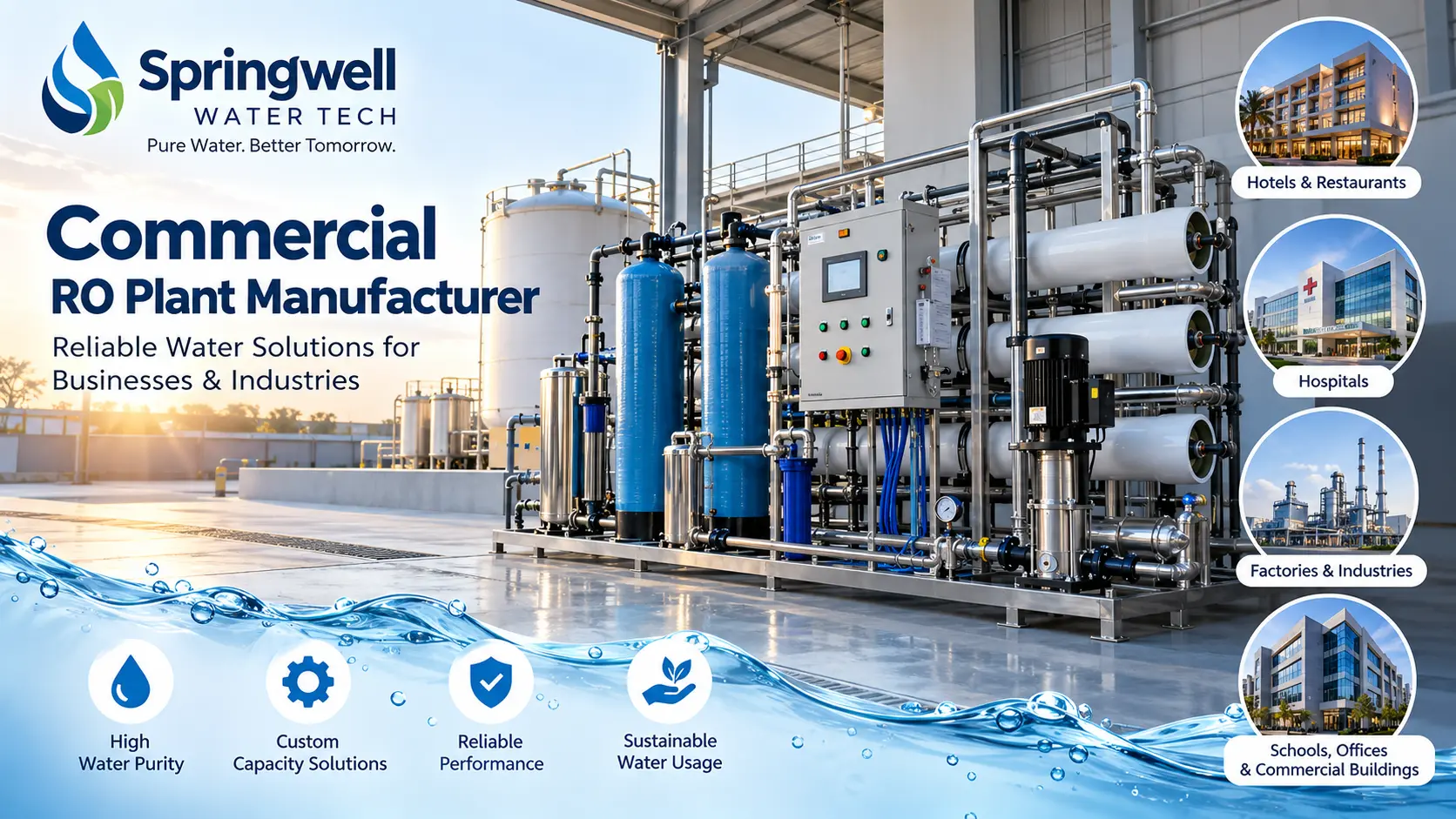
View all articlesCommercial RO Plant Manufacturer: How to Choose the Right System for Your Business
Choosing a commercial RO plant manufacturer? Learn how to assess water quality, capacity, recovery, operating costs and supplier support before buying.
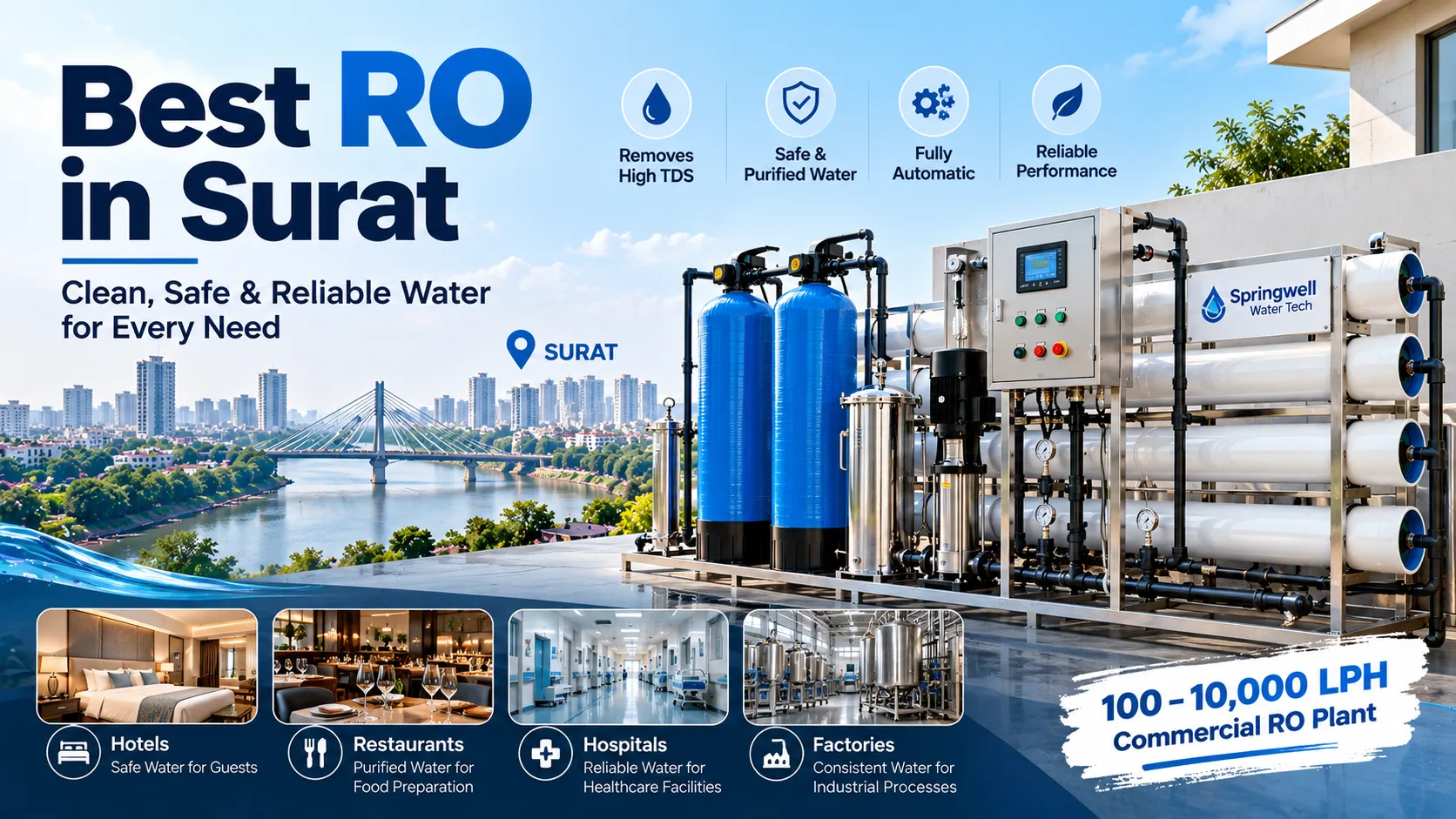
The Best RO Plant in Surat: How to Choose the Right Water Purifier (2026)
A practical guide to choosing the right RO water purifier or commercial RO plant for homes, offices, restaurants, hotels and industries in Surat.