Commercial RO Plant Manufacturer: How to Choose the Right System for Your Business
Choosing a commercial RO plant manufacturer? Learn how to assess water quality, capacity, recovery, operating costs and supplier support before buying.

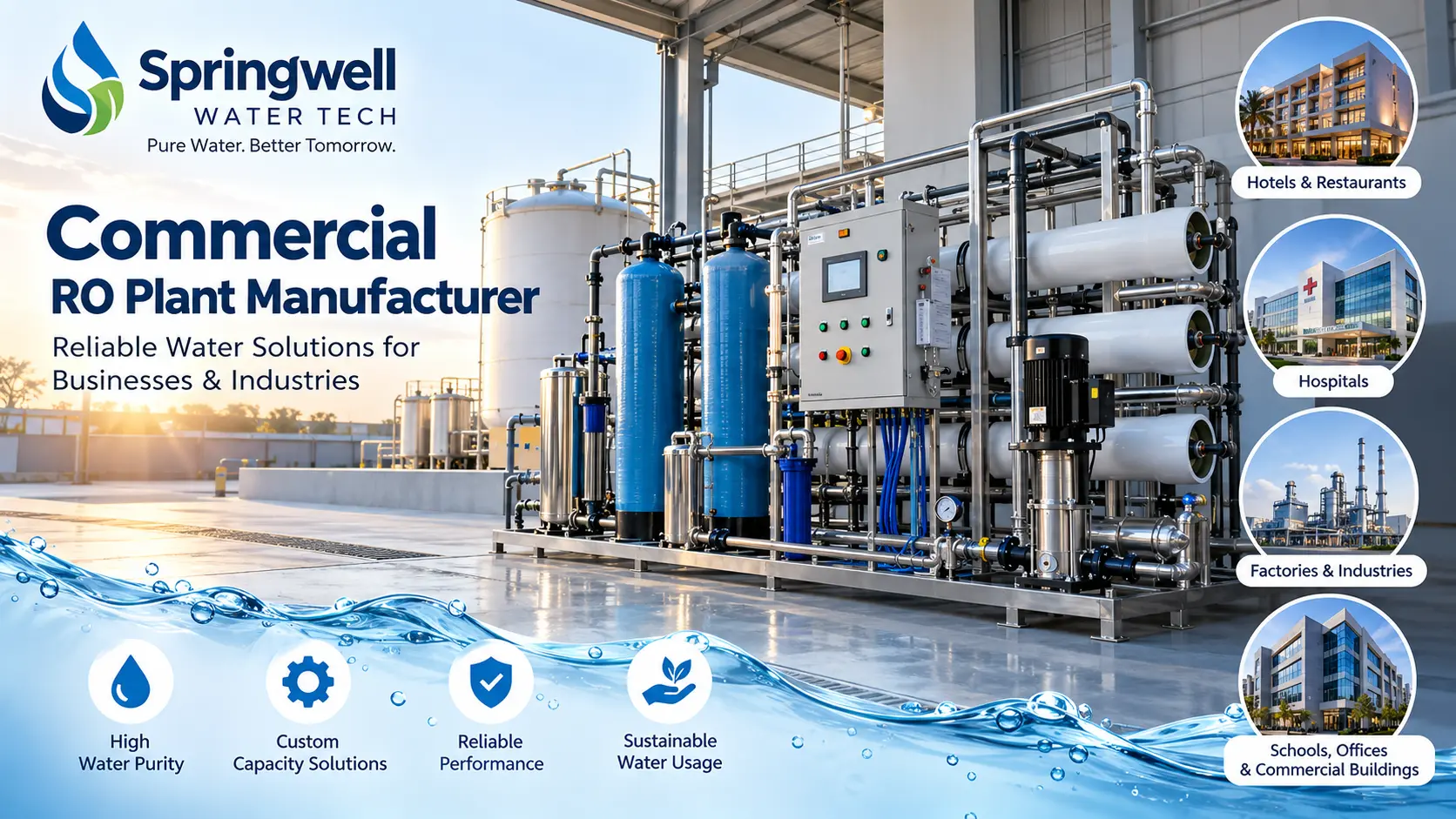
Choosing a commercial RO plant is not just about buying a machine with the right litres-per-hour rating. The system has to suit your source water, the quality you need at the outlet, how much water your business uses, and the time available to produce it. A plant that looks suitable on paper can become expensive to operate if the water analysis or daily demand was misunderstood at the start.
If you are comparing a commercial RO plant manufacturer or supplier, begin with your water test report and actual usage—not with a brochure alone. This guide explains what to check, which questions to ask, and how to compare proposals for a business or industrial site.
Springwell Water Tech provides water-treatment solutions, including commercial RO plants. If you already know your approximate capacity and application, you can share your requirements for a quotation or explore the commercial RO plant solution.
What does a commercial RO plant manufacturer provide?
A commercial reverse osmosis (RO) plant uses pressure to move feed water through a semi-permeable membrane. The membrane allows water to pass through while rejecting a portion of dissolved salts and other constituents into a separate reject stream. The actual result depends on the incoming water, membrane selection, operating conditions and system design.
Depending on the provider, a commercial RO project may include water assessment, system design, equipment supply or assembly, pretreatment, installation, commissioning and after-sales service. These services are not automatically included in every quotation, so ask the supplier to state exactly what is covered.
Also clarify whether the company manufactures the complete plant, assembles a system from sourced components, or supplies and installs equipment made by another manufacturer. Clear wording helps you compare providers fairly and understand who is responsible if something needs attention later.
Start with the water, not the machine
Two sites can both report a high TDS reading and still need different treatment arrangements. TDS tells you about the total concentration of dissolved substances; it does not identify every substance in the water or explain every treatment challenge.
Before selecting a commercial RO plant, arrange a suitable water analysis. Depending on the source and intended use, the assessment may need to consider:
- TDS and conductivity: Useful indicators of dissolved substances in the feed water.
- Hardness and alkalinity: Important when assessing scaling risk and pretreatment.
- Turbidity and suspended solids: Relevant to filtration and membrane protection.
- Iron, manganese and silica: May affect system design or require additional treatment when present at problematic levels.
- pH and temperature: Factors that can influence membrane performance and operating limits.
- Application-specific contaminants: Other chemical or microbiological parameters may need testing, depending on the use of the treated water.
For borewell or changing-source water in Surat and elsewhere in Gujarat, do not select a plant from a handheld TDS reading alone. Use a reliable water-test report and tell the supplier how the treated water will be used. Water intended for drinking, food preparation, equipment or a manufacturing process may have different quality requirements.
How much capacity does your business actually need?
Commercial RO plant capacity is commonly expressed in litres per hour (LPH). The right capacity depends on daily demand, operating hours, peak use, storage and the time the plant may be unavailable for maintenance.
For a first estimate, divide the daily quantity of treated water you need by the number of hours you plan to run the plant.
Estimated average output required = Daily treated-water demand ÷ Planned operating hours
For example, if a facility needs 4,000 litres per day and expects to operate the plant for eight hours, the average output requirement is 500 litres per hour. This is only a starting estimate. The final design should account for peak demand, actual feed-water conditions, storage, downtime and the required product-water quality.
Springwell's commercial RO offering includes stated capacities from approximately 100 to 10,000 LPH, depending on the system configuration and project requirements. Ask the supplier to confirm the rated output under the conditions assumed in the proposal rather than relying on the capacity figure alone.
What happens inside a commercial RO system?
A commercial RO plant is usually a treatment train rather than a single component. The exact arrangement is designed around the feed water and the quality target, but a system may include the following stages:
- Feed-water supply: Water enters from the selected source.
- Pretreatment: Filtration, softening or other suitable stages help address substances that could affect the RO membranes.
- High-pressure pump: Provides the pressure needed for the membrane process.
- RO membrane section: Produces treated permeate and a more concentrated reject stream.
- Post-treatment, if required: Additional treatment may be needed to meet the final application requirements.
- Storage and distribution: Treated water is stored and supplied to the required points of use.
Not every project needs the same filters or post-treatment stages. A useful proposal should explain why each major component is included and how the design relates to the water analysis.
Recovery rate: the number buyers should understand
RO recovery is the percentage of feed water that becomes treated permeate. It matters because the balance leaves the system as reject water and must be managed appropriately.
Recovery (%) = (Treated permeate volume ÷ Feed-water volume) × 100
For example, if a plant receives 1,000 litres of feed water and produces 650 litres of permeate, recovery is 65% under those conditions.
Recovery is not a universal fixed number. Feed-water composition, scaling potential, temperature, pressure, membrane arrangement and operating settings all affect what is appropriate. Springwell's commercial RO offering lists recovery in the approximate range of 60–75%, subject to feed-water quality and system design. Ask for the expected recovery for your particular water report, along with the projected reject-water volume.
Which businesses use commercial RO plants?
Hotels and restaurants
Hotels and restaurants may need treated water for drinking, cooking, beverage preparation or selected operational uses. Estimate demand by service period and confirm the quality required for each use instead of sizing the plant from the number of rooms or seats alone.
Hospitals and healthcare facilities
Healthcare facilities can have several distinct water requirements. A general commercial RO plant should not be assumed to meet specialised clinical or medical-equipment requirements automatically. Confirm the relevant water-quality specification and any additional treatment needed for the intended use.
Factories and manufacturing units
Manufacturers may use treated water in production, cleaning, utilities or equipment. The correct configuration depends on the process and the consequences of water-quality variation. Share the process requirement with the supplier rather than requesting a plant based only on a target TDS value.
Schools, colleges, offices and commercial buildings
For drinking-water applications, consider occupancy, peak usage, storage hygiene and the required water quality. For other building uses, assess those needs separately; not every use requires the same RO treatment.
How to compare commercial RO plant quotations
When comparing suppliers, ask each one to quote against the same information. Otherwise, two prices may cover very different equipment and responsibilities.
| What to compare | Question to ask |
|---|---|
| Design basis | Which water-test results and operating conditions were used? |
| Capacity | What permeate output should we expect under the stated conditions? |
| Product-water target | Which quality parameters will be checked at commissioning? |
| Pretreatment | Which filters or other treatment stages are included, and why? |
| Core components | Are membrane, pump and control-panel makes and models listed? |
| Recovery and reject water | What recovery is expected, and how much reject water will be produced? |
| Installation | Are piping, electrical work, drainage and commissioning included? |
| Operating costs | What power, consumables, cleaning and maintenance should be budgeted for? |
| Service and warranty | What is covered, for how long, and who responds to service requests? |
The lowest purchase price is not always the lowest-cost option over time. A meaningful comparison includes the proposed treatment stages, expected operating requirements, replacement consumables, service arrangements and the written warranty terms.
What affects the cost of a commercial RO plant?
There is no single price that fits every commercial RO project. Cost depends on capacity, feed-water quality, pretreatment, membrane and pump specifications, automation, construction materials, installation scope and the intended application.
A supplier can prepare a more useful quotation when you provide:
- Your water source and a recent water-test report.
- The required litres per hour and litres per day.
- The intended use of the treated water.
- Any required product-water quality limits.
- Daily operating hours and peak demand.
- Site details, available space and any installation constraints.
- Your expectations for automation, monitoring and after-sales support.
Be cautious of a quote that promises a specific output or water quality without explaining the feed-water conditions and design assumptions. Ask for the scope and performance expectations in writing.
Choosing a commercial RO plant supplier in Surat and Gujarat
Local service can be helpful when a site needs a survey, installation coordination or ongoing maintenance. But a nearby address alone is not enough to judge a supplier. Check the quality of the technical assessment and the clarity of the proposal.
Before making a decision, confirm that the provider can explain:
- How the water analysis affects the system design.
- Why the proposed capacity suits your operating schedule.
- What water quality and recovery are expected—and under which conditions.
- Which work is included in installation and commissioning.
- What routine maintenance, consumables and service support are required.
Springwell Water Tech serves domestic and commercial water-treatment needs, including commercial RO plants, water softeners and filtration systems. Businesses in Surat and across Gujarat can contact Springwell to discuss their water source, application and required capacity.
Frequently asked questions
What is a commercial RO plant manufacturer?
A commercial RO plant manufacturer produces or builds reverse osmosis systems for business applications. Some providers also design, assemble, supply, install or maintain systems. Ask the company to clarify which services it performs directly and which are handled by partners.
How do I select the right commercial RO plant?
Start with a suitable water analysis, define the intended use and required treated-water quality, estimate daily demand and operating hours, and then compare system proposals. The design should account for pretreatment, capacity, recovery, installation and maintenance.
Can a commercial RO plant treat borewell water?
It can be designed for suitable borewell water, but the required configuration depends on the water analysis. Parameters such as TDS, hardness, suspended solids, iron and silica can influence pretreatment, membrane selection and recovery.
What is the difference between a commercial and industrial RO plant?
The terms overlap. Commercial systems often serve businesses and institutions, while industrial systems are commonly designed around manufacturing or process-water requirements. Capacity, treatment targets and operating conditions matter more than the label alone.
What recovery rate should I expect from an RO plant?
Recovery depends on the feed water and system design. Ask the supplier to state the expected recovery for your water analysis and calculate the related reject-water volume. A recovery figure should not be treated as universal across all installations.
Does RO remove every contaminant from water?
No system should be assumed to remove every possible contaminant under all conditions. Performance depends on the membrane, water composition, operating conditions and any additional treatment. Verify the relevant water-quality parameters for your intended use.
How often does a commercial RO plant need maintenance?
The schedule depends on water quality, operating hours, pretreatment performance and manufacturer guidance. Routine checks may include flow, pressure, treated-water quality, pretreatment filters and membrane performance. Follow the maintenance plan specified for the installed system.
How can I request a commercial RO plant quotation in Surat?
Share your water-test report, required capacity, daily operating hours and intended application with the supplier. You can contact Springwell Water Tech for a quotation and discuss the appropriate system configuration.
Plan the system around your water and your work
A good commercial RO plant decision begins with a clear understanding of the water—not with a model name or headline capacity. When the water analysis, demand, target quality and operating schedule are documented, it becomes much easier to compare suppliers and avoid paying for a system that does not match the real requirement.
If you are evaluating a commercial RO plant for a business in Surat or elsewhere in Gujarat, review Springwell's commercial RO plant solution and share your project requirements for a discussion.
Vimal Sutariya
Vimal Sutariya has over 12 years of hands-on field experience designing and installing water softening plants, commercial RO systems, and booster pumps across Surat, Hazira, Sachin GIDC, and South Gujarat.
Planning a Commercial RO System for Your Business?
Discuss your water quality, daily demand, and application requirements with Springwell Water Tech to identify a suitable water treatment solution tailored to your facility.
Related Water Treatment Guides
View all articles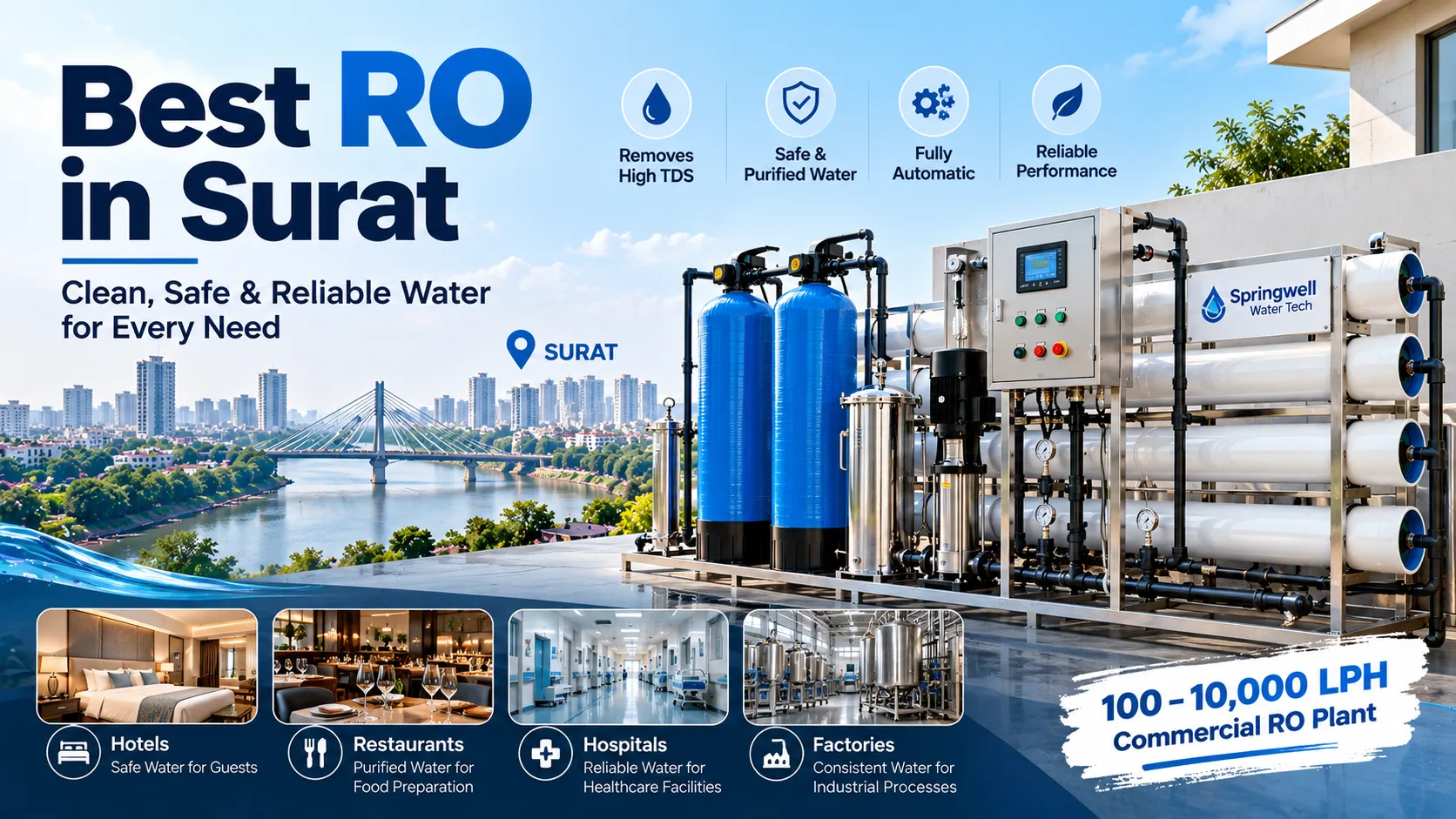
The Best RO Plant in Surat: How to Choose the Right Water Purifier (2026)
A practical guide to choosing the right RO water purifier or commercial RO plant for homes, offices, restaurants, hotels and industries in Surat.
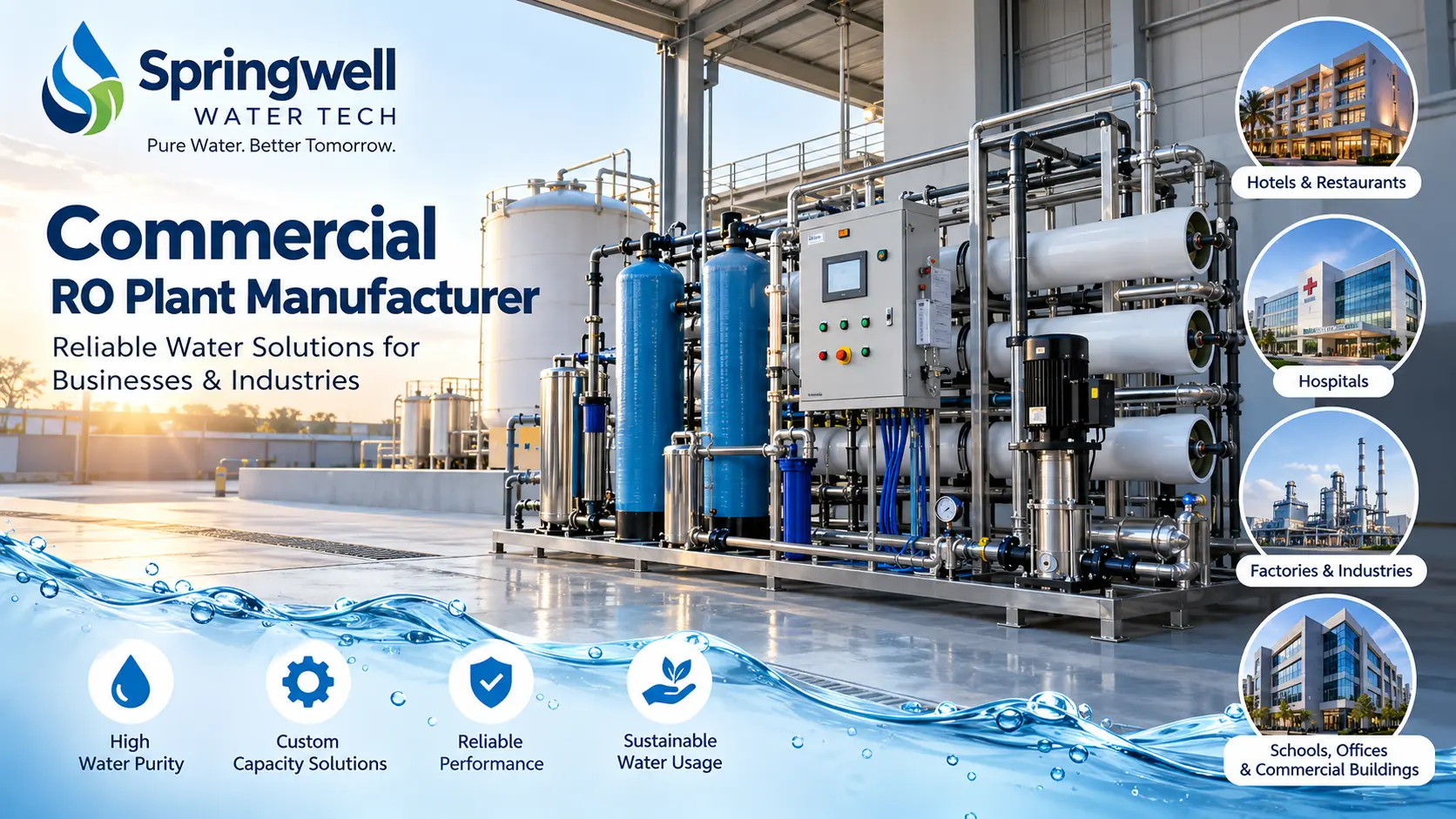
Industrial Water Treatment Plant Manufacturer: A Practical Guide for Businesses
Looking for an industrial water treatment plant manufacturer? Learn how to choose a suitable system based on water quality, capacity, use, and operating needs.