Industrial Water Treatment Plant Manufacturer: A Practical Guide for Businesses
Looking for an industrial water treatment plant manufacturer? Learn how to choose a suitable system based on water quality, capacity, use, and operating needs.

Water plays an important role in many industries. It may be used for cleaning, production, heating, cooling, rinsing, or other day-to-day operations. But water from a borewell, municipal supply, or another source may not have the quality a business needs. Depending on its source, it may contain excess dissolved salts, hardness, suspended particles, or other unwanted substances.
That is why choosing the right industrial water treatment plant manufacturer matters. A suitable system should be selected around your source water, the quality your process requires, the amount of water you use, and the conditions at your site—not simply by choosing the biggest plant or the lowest quotation.
Springwell Water Tech provides water treatment solutions for domestic and commercial requirements. If you are planning an industrial project, use the points in this guide to understand what to discuss with a water treatment supplier and what information to prepare before requesting a quotation.
What Does an Industrial Water Treatment Plant Manufacturer Do?
An industrial water treatment plant manufacturer designs and builds systems intended to treat water for a particular application. Depending on the business and the raw water, a treatment setup may use filtration, softening, reverse osmosis (RO), or a combination of processes.
The exact system is not the same for every factory. A food-processing unit may have different water-quality requirements from a textile facility, hotel, engineering plant, or cooling-water application. The treatment process should therefore be selected after understanding the intended use and testing the incoming water.
When comparing providers, clarify whether the company manufactures the equipment itself, supplies equipment from other manufacturers, or designs and integrates a complete treatment system. These are different roles, and understanding the provider's role helps you compare quotations fairly.
Which Industrial Water Treatment System Does Your Business Need?
The right treatment method depends on what needs to be removed or controlled. The following are common options, but they are not interchangeable. A water test and an understanding of your process should guide the final selection.
1. Industrial Water Filtration
Filtration can help reduce suspended particles such as sand, sediment, and other visible impurities, depending on the filter media and system design. It is often used as a pre-treatment step to protect downstream equipment. The filter type and size should match the incoming water quality and flow rate.
2. Industrial Water Softener
Hard water contains minerals—mainly calcium and magnesium—that can contribute to scale formation. A water softener uses an appropriate treatment process, commonly ion exchange, to reduce hardness. Softening may be useful for applications such as boiler feed pre-treatment, washing, and equipment protection, depending on the overall system design.
3. Industrial Reverse Osmosis (RO) Plant
Reverse osmosis uses a membrane to reduce many dissolved substances in water. An industrial RO plant may be considered when the application needs lower dissolved-solids levels than the source water provides. Its design depends on factors such as feed-water analysis, required product-water quality, flow demand, pre-treatment, and the planned handling of reject water.
4. Multi-Stage Water Treatment System
Some sites need more than one treatment step. For example, filtration may be followed by softening or RO, depending on the water analysis and intended use. A multi-stage system should be designed as a complete process so that each stage supports the next one.
How to Choose the Right Industrial Water Treatment Plant
Before selecting a supplier or approving a design, work through these practical questions.
1. Test Your Source Water
Start with a reliable water analysis. Depending on your application, useful parameters may include total dissolved solids (TDS), hardness, pH, turbidity, iron, and other relevant chemical or microbiological parameters. Not every project needs every test; the required analysis depends on the source and intended use.
Do not rely on TDS alone to select a treatment plant. TDS is only one indicator of water quality and does not describe every substance that may affect your process.
2. Calculate Your Actual Water Demand
Estimate how much treated water you need per hour and per day. Include peak demand, operating hours, production schedules, cleaning requirements, and any planned expansion. A plant that is too small may not meet demand, while an unnecessarily large system can increase capital and operating costs.
Ask the supplier to explain the proposed capacity and the assumptions used to calculate it. If demand varies throughout the day, storage tanks or a suitable operating schedule may also need to be considered.
3. Define the Required Treated-Water Quality
Explain what the water will be used for. Water used for equipment washing may have different requirements from water used as a process ingredient, boiler feed, cooling, or another sensitive application. Share any relevant process requirements or standards with the designer before the system is specified.
4. Review Pre-Treatment and Post-Treatment
RO membranes and other treatment components can be affected by feed-water conditions. Ask what pre-treatment is proposed, why it is needed, and which maintenance tasks it requires. Depending on the application, post-treatment or disinfection may also be necessary. These decisions should be based on the water analysis and the intended use.
5. Understand Reject Water and Operating Costs
RO systems produce a treated-water stream and a reject stream. The amount of reject water depends on feed-water quality, system design, operating conditions, and the recovery target. Ask the supplier to state the expected recovery for your specific project rather than assuming one percentage applies to every installation.
Also discuss electricity use, consumables, membrane or media replacement, chemicals where applicable, servicing, and the safe, lawful handling of reject water. These ongoing costs are part of the system's overall value.
6. Check Service and Documentation
Ask what documentation will be provided, such as the proposed process flow, equipment specifications, operating instructions, maintenance schedule, and warranty terms. Confirm who will install and commission the system, who will train operators, and how service requests are handled.
Industries That May Need Industrial Water Treatment
Industrial water treatment can support many different types of facilities. The appropriate process depends on the application and water-quality requirements.
- Manufacturing and engineering: Water may be needed for cleaning, rinsing, production, or equipment support.
- Textile and garment processing: Water quality can affect washing, processing, and other production steps.
- Food and beverage: Treatment requirements should be matched to the specific process and applicable hygiene or quality standards.
- Hotels, hospitals, and large buildings: Filtration or softening may be considered for selected utility and service-water applications.
- Boiler and cooling-water systems: Treatment may help control scale or other water-related problems when designed for the equipment and operating conditions.
- Educational and institutional facilities: Treatment can be planned around source water, demand, and the intended use.
These examples are not a recommendation to use one standard design across all industries. The system should be specified for the actual application, and drinking-water or process-water uses may have additional requirements.
What Information Should You Share When Requesting a Quotation?
Providing the right details helps a supplier assess your needs and prepare a more useful proposal. Before requesting a quotation, try to collect:
- Your site location and type of industry.
- The source of water, such as borewell, municipal supply, or another source.
- A recent water-analysis report, if available.
- Required treated-water quality and intended use.
- Estimated hourly and daily water demand.
- Daily operating hours and any peak-demand periods.
- Available installation space and utility details, if known.
- Any requirements for automation, storage, monitoring, or service support.
If you do not have all these details yet, start with the information you have. A qualified provider can explain which additional tests or measurements are needed before a final design is proposed.
How to Compare Industrial Water Treatment Plant Quotations
It is tempting to compare suppliers by the total price alone. However, two quotations may describe systems with different capacities, treatment stages, included equipment, and operating assumptions. Compare the scope before comparing the final amount.
| What to Compare | Questions to Ask |
|---|---|
| Design basis | Is the proposal based on my water analysis and intended use? |
| Capacity | What treated-water output is expected under the stated operating conditions? |
| Treatment stages | Which pre-treatment, main treatment, and post-treatment stages are included? |
| Equipment scope | Are pumps, tanks, controls, piping, installation, and commissioning included or excluded? |
| Operating requirements | What are the estimated electricity, consumable, maintenance, and reject-water requirements? |
| Service and warranty | What warranty terms, maintenance support, documentation, and operator training are provided? |
A clear quotation should explain what is included, what is excluded, and which performance assumptions apply. Request clarification in writing if an important item is not specified.
How Much Does an Industrial Water Treatment Plant Cost?
There is no single price that applies to every industrial water treatment plant. The total cost depends on the type of treatment, required capacity, raw-water quality, target treated-water quality, equipment and material specifications, automation, installation conditions, and service requirements.
A small filtration setup and a multi-stage industrial RO system are different projects, so comparing their prices without comparing the scope can be misleading. The purchase price is only one part of the decision; power, consumables, maintenance, replacement parts, and reject-water handling may also affect long-term operating costs.
For a meaningful estimate, share your water-analysis report, required capacity, application, and site details with the supplier. If the water quality has not yet been tested, ask what analysis is needed before a firm recommendation is made.
Choosing an Industrial Water Treatment Partner in Surat and Gujarat
If your facility is in Surat or elsewhere in Gujarat, consider how the provider will support the project after the equipment is delivered. A suitable partner should be willing to understand your application, explain the proposed treatment process in plain language, provide a clear scope, and discuss installation and ongoing service.
Before making a decision, ask for relevant project experience and technical documentation that can be verified. Confirm the provider's actual role—manufacturer, supplier, or system integrator—and avoid relying on broad claims that are not supported by the proposal or product documentation.
Springwell Water Tech offers water treatment solutions for domestic and commercial needs. For an industrial requirement, share your application and available water-quality information so the team can discuss whether its offering is suitable for your project.
Contact Springwell Water Tech to discuss your requirements, or visit the filtration systems page to explore relevant water-treatment solutions.
Frequently Asked Questions
What is an industrial water treatment plant?
An industrial water treatment plant is a system that treats water to meet the needs of a particular industrial or commercial application. Depending on the source water and intended use, it may include filtration, softening, reverse osmosis, or other treatment stages.
How do I choose an industrial water treatment plant manufacturer?
Start with your water analysis, required treated-water quality, and hourly and daily demand. Then compare providers on the proposed design, equipment scope, operating requirements, documentation, warranty, and service support. Also confirm whether the company manufactures the equipment or supplies and integrates systems.
Is an industrial RO plant suitable for every factory?
No. RO is useful when the application requires a reduction in dissolved substances, but it is not the right answer for every water problem. Some applications may need filtration, softening, another process, or a combination of treatments. A water analysis and a clear definition of the required water quality help determine the right option.
What capacity industrial water treatment plant do I need?
The required capacity depends on hourly demand, daily consumption, operating hours, peak use, and any storage or future expansion plans. Share these details with the designer so the proposed output can be calculated for your site.
Why is water testing important before selecting a plant?
Water testing helps identify the characteristics that the treatment system needs to address. Without an appropriate analysis, it is difficult to select the right treatment stages or estimate how the system will operate. The tests required depend on the source water and the intended application.
What affects the operating cost of an industrial water treatment system?
Operating costs may include electricity, filter media or cartridge replacement, RO membranes where applicable, treatment chemicals, maintenance, labour, and reject-water handling. The actual cost depends on the system design, water quality, operating schedule, and local conditions.
Can a supplier quote a plant without a water-analysis report?
A supplier may be able to provide an initial discussion or budget estimate using preliminary information. However, a reliable final design should be based on sufficient water-quality data and a clear understanding of the intended use and required output.
Plan Your Industrial Water Treatment Project
The best industrial water treatment plant is one that matches your source water, production needs, treated-water quality, site conditions, and long-term operating plan. Start by gathering your water analysis and demand estimates, then ask providers to explain the design and operating assumptions behind their proposals.
Need to discuss a water treatment requirement? Contact Springwell Water Tech and share your application, water source, and expected demand. The available details will help determine the next steps for assessing a suitable solution.
Vimal Sutariya
Vimal Sutariya has over 12 years of hands-on field experience designing and installing water softening plants, commercial RO systems, and booster pumps across Surat, Hazira, Sachin GIDC, and South Gujarat.
Planning a Commercial RO System for Your Business?
Discuss your water quality, daily demand, and application requirements with Springwell Water Tech to identify a suitable water treatment solution tailored to your facility.
Related Water Treatment Guides
View all articles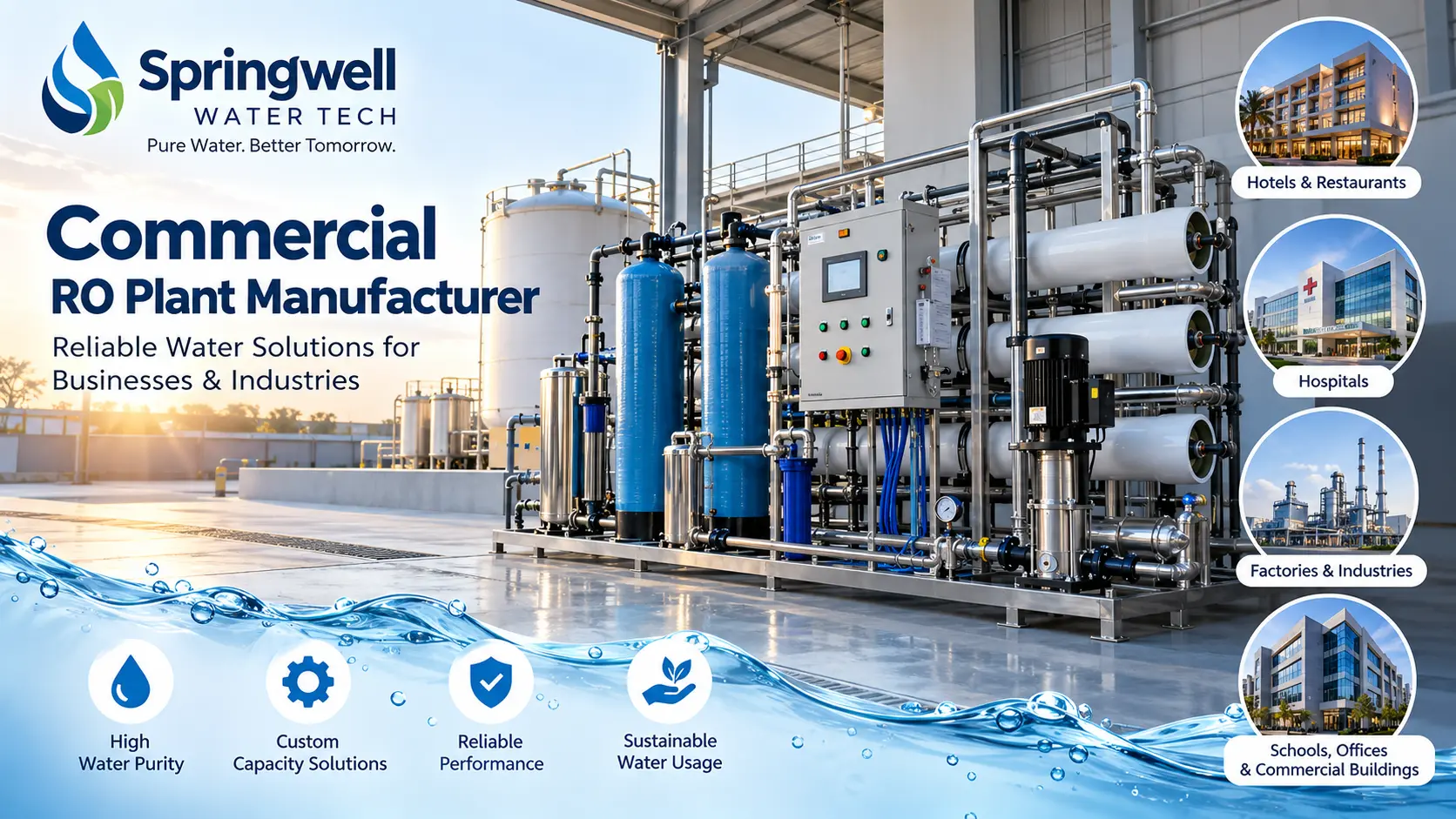
Commercial RO Plant Manufacturer: How to Choose the Right System for Your Business
Choosing a commercial RO plant manufacturer? Learn how to assess water quality, capacity, recovery, operating costs and supplier support before buying.
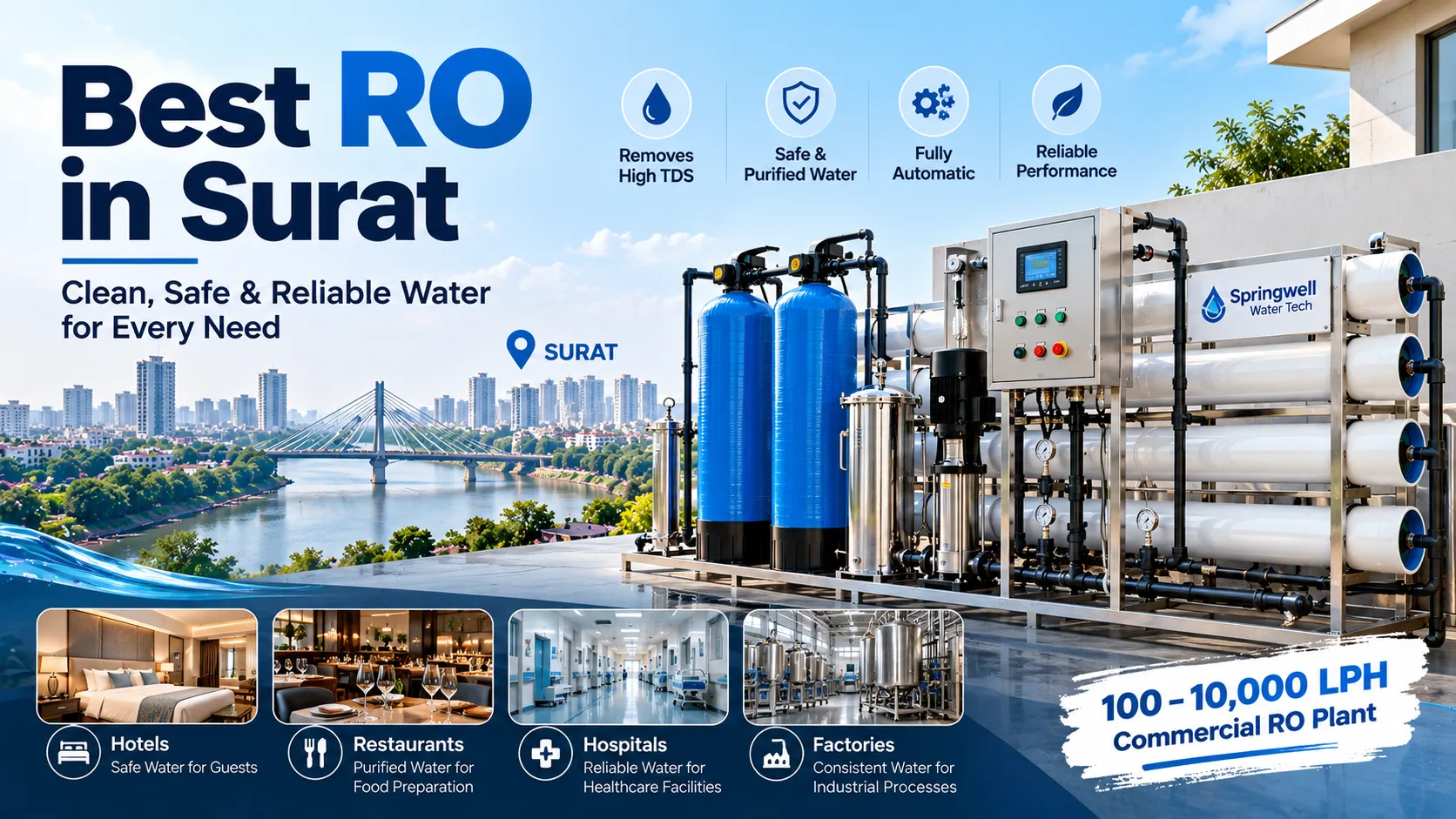
The Best RO Plant in Surat: How to Choose the Right Water Purifier (2026)
A practical guide to choosing the right RO water purifier or commercial RO plant for homes, offices, restaurants, hotels and industries in Surat.