The Best RO Plant in Surat: How to Choose the Right Water Purifier (2026)
A practical guide to choosing the right RO water purifier or commercial RO plant for homes, offices, restaurants, hotels and industries in Surat.

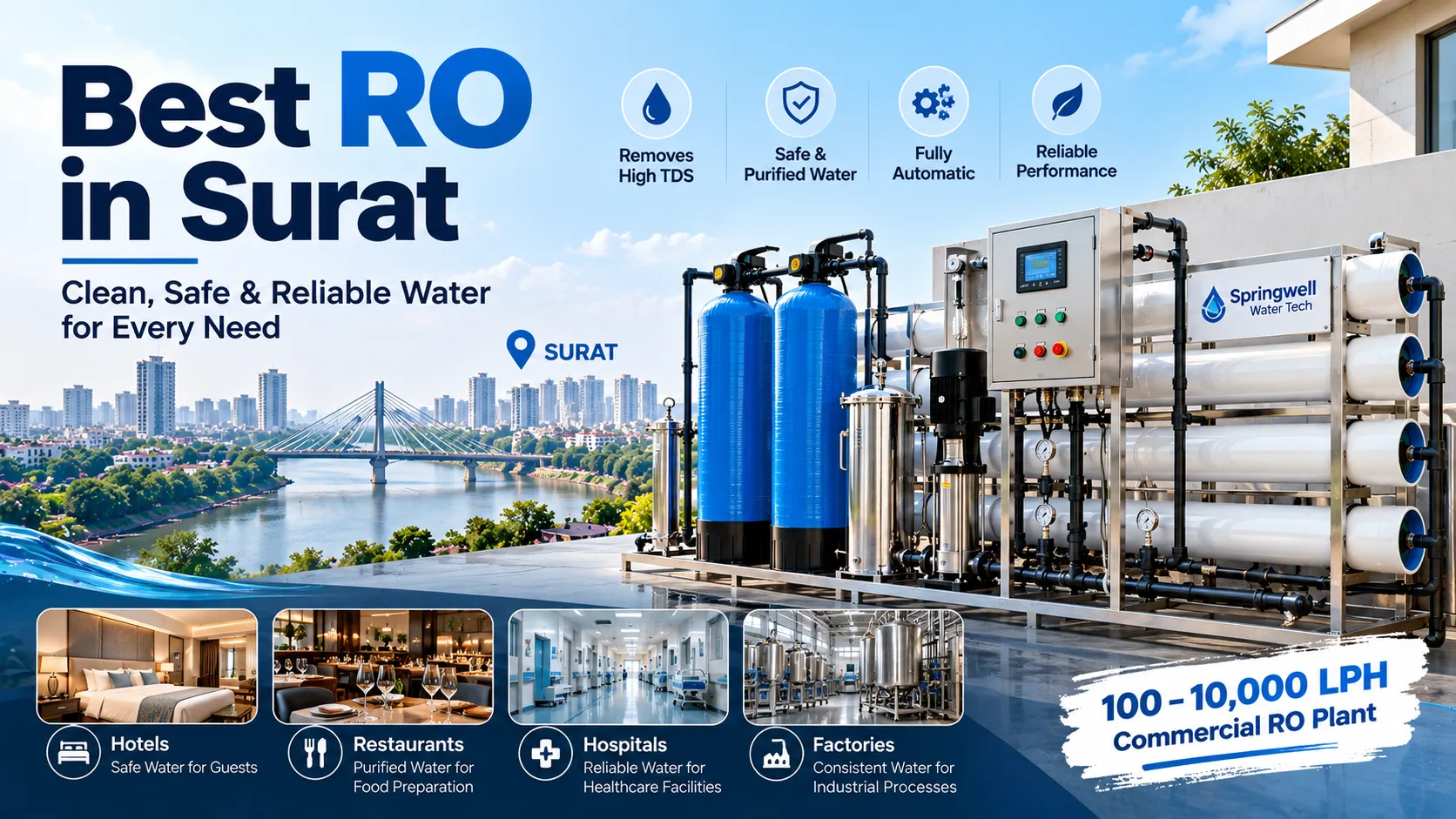
Quick Answer: If you are looking for the best RO in Surat, start with your water rather than the brand name. A domestic RO may be suitable for a household drinking-water requirement, while hotels, restaurants, offices, hospitals and factories may need a properly sized commercial RO plant. Water quality, TDS, hardness, daily consumption and required capacity should all be considered before selecting an RO system.
Water quality is an important consideration for homes and businesses across Surat. Depending on the property and its water source, you may be dealing with municipal water, borewell water or a combination of sources.
When groundwater or borewell water is part of the supply, parameters such as TDS, hardness and other dissolved substances can become important when selecting a suitable water-treatment system.
That is why choosing the best RO in Surat is not simply about buying the most expensive purifier or the model with the highest specifications. The right system is the one that matches your actual water quality and daily requirement.
In this guide, we will look at how to choose an RO system for a home or business, when a commercial RO plant makes sense, what capacity means and why water testing should come before finalizing your system.
Why Does Water Quality Matter When Choosing an RO in Surat?
Not every water source has the same characteristics. A property receiving municipal water can have a different water profile from a property using borewell water.
Even among borewell sources, water quality can vary depending on location, depth and local geological conditions.
This means an RO system that works well for one property may not necessarily be the right choice for another.
Before choosing a water purifier in Surat, it is useful to understand the source water and check the relevant parameters.
Important Water Quality Parameters
- TDS – Total Dissolved Solids
- Total Hardness – Mainly associated with calcium and magnesium
- pH – Indicates the acidity or alkalinity of water
- Iron – Important where groundwater contains elevated iron
- Chloride – Can affect water characteristics and taste
- Other parameters depending on the source and intended application
The exact treatment process should be selected after understanding the water analysis and the required treated-water quality.
What Is the Best RO for a Home in Surat?
For a typical household, the first question is whether an RO system is actually required and what type of treated water the family needs.
If the home has a drinking-water requirement involving higher dissolved solids or other parameters that can be addressed through reverse osmosis, a domestic RO system may be considered.
However, the right configuration depends on the source water.
For example, a home using borewell water with significant hardness may require appropriate pretreatment depending on the water analysis and RO design.
Things to Check Before Buying a Domestic RO
- Raw-water TDS
- Water hardness
- Required daily drinking-water quantity
- Pre-filtration requirements
- Storage capacity
- Replacement filter requirements
- Membrane specifications
- After-sales service
Instead of selecting a domestic RO only because it has a large number of purification stages, look at whether those stages are appropriate for your actual water quality.
Does a High TDS Level Always Mean You Need an RO?
Not necessarily.
TDS is an important water-quality measurement, but it does not describe every characteristic of water.
For example, TDS and water hardness are not the same thing. Hardness is mainly associated with calcium and magnesium, while TDS represents the total concentration of dissolved substances measured by the relevant testing method.
If hardness is the primary concern in a home, a water softener may be more appropriate for that particular problem than using RO as a whole-house hardness solution.
You can learn more about this in our guide to Water Softening Solutions .
RO vs Water Softener: Which One Do You Need?
| Requirement | RO System | Water Softener |
|---|---|---|
| Primary purpose | Membrane-based reduction of many dissolved substances | Primarily reduces hardness-causing calcium and magnesium |
| TDS reduction | One of the main applications | Not designed as a general TDS-removal system |
| Hardness treatment | Can reduce dissolved minerals through RO | Specifically designed for hardness reduction |
| Typical residential application | Drinking and other treated-water requirements | Whole-house or selected water lines where hardness is the main concern |
In some properties, both systems may be part of the overall water-treatment strategy because they address different water-quality requirements.
When Should You Choose a Commercial RO Plant?
A household RO purifier is designed for relatively small water requirements. A business or institution may need considerably more treated water throughout the day.
This is where a commercial RO plant in Surat becomes relevant.
Commercial RO systems can be used for applications such as:
- Hotels
- Restaurants
- Hospitals
- Factories
- Schools
- Colleges
- Malls
- Offices
- Large institutions
The required system should be designed around the property's actual water demand and the required treated-water quality.
How Much RO Capacity Do You Need?
One of the biggest mistakes businesses make is choosing an RO plant only by looking at the LPH number.
LPH means litres per hour, and it indicates the production capacity of the RO system under its specified operating conditions.
For example, a business requiring 10,000 litres of treated water every day and operating the plant for approximately 10 hours would have an average production requirement of around 1,000 litres per hour.
But this calculation alone is not enough to finalize the plant.
Storage capacity, peak demand, operating schedule, recovery and raw-water conditions should also be considered.
Springwell Commercial RO Plant in Surat
Springwell Water Tech provides commercial RO plants in Surat for businesses and institutions requiring higher-volume treated water.
The current commercial RO offering supports capacities from:
100 LPH to 10,000 LPH
The available system specifications include:
- 100–10,000 LPH capacity range
- Maximum TDS up to 10,000 TDS, subject to system design and water conditions
- 60–75% recovery
- Fully automatic operation
- Three-phase industrial power
- Industrial RO membranes
- PLC-based automation
- Energy recovery system
- Remote monitoring capability
- Stainless-steel construction
The final configuration should always be selected according to the raw-water analysis, required capacity and intended application.
Explore Springwell Commercial RO Plant
Best RO Plant for a Restaurant in Surat
Restaurants can require treated water for food preparation, kitchen operations, cleaning and other daily activities.
A commercial RO plant for a restaurant should therefore be sized according to actual water consumption rather than simply selecting a large-capacity machine.
Before installation, consider:
- Daily water requirement
- Kitchen usage
- Peak demand
- Operating hours
- Storage capacity
- Raw-water quality
- Required treated-water quality
Best RO Plant for a Hotel in Surat
Hotels can have water requirements across guest rooms, kitchens, housekeeping, laundry and other operations.
The right RO plant for a hotel depends on where treated water will be used and how much water is required during normal and peak periods.
Room count can provide context, but it should not be the only factor used for capacity selection.
Best RO Plant for a Factory in Surat
Industrial facilities can have very different water requirements depending on their manufacturing process.
For example, a textile unit may have different requirements from a food-processing facility or another manufacturing operation.
An industrial RO plant in Surat should therefore be designed around:
- Raw-water characteristics
- Process requirements
- Daily water demand
- Peak flow
- Required treated-water quality
- Operating schedule
For industrial applications, water testing and process requirements should be reviewed before the final RO configuration is selected.
Why Water Testing Should Come Before Buying an RO
If you are searching for the best RO in Surat, water testing should be one of the first steps.
A water test helps determine whether the main concern is TDS, hardness, iron, chloride or another parameter.
It can also help identify whether pretreatment is required before the RO membrane.
A practical process is:
- Identify the water source.
- Collect a representative water sample.
- Test the relevant water-quality parameters.
- Determine daily and peak water demand.
- Establish the required treated-water quality.
- Select the appropriate treatment configuration.
- Finalize the RO capacity and installation arrangement.
Why Pretreatment Matters for RO Systems
RO membranes are sensitive to certain water-quality conditions. Depending on the raw water, pretreatment may be required to protect the membrane and support reliable operation.
The pretreatment arrangement depends on the actual water analysis.
Depending on the application, a water-treatment system may include filtration or other pretreatment stages before the RO process.
This is particularly important when the incoming water contains conditions that could contribute to fouling or scaling.
For homes with significant hardness, a water softener may sometimes be considered as part of the overall treatment arrangement when appropriate for the application.
What Is RO Recovery?
RO recovery describes the proportion of feed water converted into treated permeate under the specified operating conditions.
For example, at 70% recovery, approximately 70 litres of permeate could theoretically be produced from 100 litres of feed water under the specified conditions.
The remaining water becomes concentrate and needs to be managed appropriately.
Actual recovery depends on membrane configuration, raw-water quality, operating conditions and system design.
Springwell's commercial RO systems are specified with a recovery range of approximately 60–75%, depending on the final system configuration.
Automatic Commercial RO Plant
For businesses that require regular water treatment, automation can make operation and monitoring more convenient.
Springwell's commercial RO plant offering includes fully automatic operation and PLC-based automation.
Remote monitoring capability is also available depending on the system configuration.
The exact automation functions should be confirmed as part of the final project specification.
How to Compare RO Plant Suppliers in Surat
When comparing an RO plant supplier in Surat, don't compare only the quoted price.
Ask about:
- RO capacity
- Raw-water compatibility
- Water testing
- Pretreatment
- Recovery
- Automation
- Installation requirements
- Maintenance requirements
- Membrane specifications
- Long-term operating requirements
A properly designed system can be more valuable than a low-cost system that does not match the site's actual water conditions.
What Makes a Good Commercial RO System?
A good commercial RO system should be appropriately designed for its application.
Important considerations include:
Correct Capacity
The plant should provide enough treated water for the site's normal and peak requirements without being unnecessarily oversized.
Suitable Pretreatment
Pretreatment should be based on the raw-water analysis and the requirements of the RO membranes.
Appropriate Automation
Automation can help manage operation and monitoring, especially in systems that run regularly.
Suitable Construction
The construction and components should be appropriate for the intended commercial or industrial application.
Service and Maintenance
A commercial RO plant is a working water-treatment system, so maintenance and periodic monitoring are important parts of its long-term operation.
Is the Most Expensive RO the Best RO?
Not necessarily.
The most expensive system is not automatically the right system for your property.
Similarly, the cheapest RO plant may not provide the best long-term value if it is incorrectly sized or poorly matched to the raw water.
The better approach is to compare the system according to:
- Water quality
- Required capacity
- Recovery
- Pretreatment
- Automation
- Construction
- Installation
- Maintenance
- Expected operating requirements
Domestic RO or Commercial RO: Which One Is Right for You?
| Requirement | Domestic RO | Commercial RO Plant |
|---|---|---|
| Typical users | Households | Businesses and institutions |
| Water requirement | Household-scale drinking water | Higher-volume treated water |
| Capacity | Consumer-scale | Higher LPH capacities |
| Installation | Compact residential installation | Dedicated commercial installation |
| System design | Generally standardized | Application-specific |
Why Choose Springwell Water Tech?
Springwell Water Tech provides water-treatment solutions for residential and commercial requirements in Surat and South Gujarat.
Our solutions include:
- Commercial RO plants
- Domestic water softeners
- Commercial water softeners
- Automatic sand filters
- Automatic carbon filters
- Swimming pool filtration systems
- Pressure pump solutions
- Hot water solutions
Our approach is to understand the water-treatment requirement and then select the appropriate system rather than treating every property the same way.
If hardness is your primary concern rather than dissolved solids, explore our Water Softening Solutions .
Frequently Asked Questions
Which is the best RO in Surat?
There is no single RO system that is best for every property. The right system depends on the raw-water quality, required capacity, treated-water requirement, application and installation conditions.
Which RO is best for borewell water in Surat?
An RO system for borewell water should be selected after testing the water. TDS, hardness, iron and other relevant parameters can influence the treatment configuration and pretreatment requirements.
What is the best commercial RO plant in Surat?
The best commercial RO plant is one that is correctly designed for the site's water quality and required capacity. Springwell provides commercial RO systems from 100 LPH to 10,000 LPH.
How much does a commercial RO plant cost in Surat?
The price depends on capacity, raw-water quality, pretreatment, automation, construction and installation requirements. A reliable quotation should be prepared after understanding the project requirements.
Can an RO remove hardness?
RO membranes can reduce many dissolved substances, including hardness-causing minerals, but the overall treatment configuration depends on the raw water and application. A water softener is specifically designed for hardness reduction and may be used where appropriate.
Does every home in Surat need an RO?
No. The need for RO depends on the water quality and the intended use. Water should be tested before deciding which treatment technology is appropriate.
What RO capacity is required for a restaurant?
The required capacity depends on the restaurant's actual daily consumption, peak demand, operating hours and treated-water requirements. Capacity should be calculated rather than selected only by business type.
Final Thoughts: Finding the Best RO in Surat
The best RO in Surat is not necessarily the most expensive machine or the one with the highest number of filtration stages.
It is the system that matches your actual water quality, required capacity and intended application.
For a home, this may mean a suitable domestic RO system. For a restaurant, hotel, hospital or factory, it may mean a properly designed commercial RO plant.
Start with a water test. Understand your TDS and hardness, calculate your daily and peak water requirements, and then select the treatment system accordingly.
For commercial requirements, Springwell Water Tech provides RO systems from 100 LPH to 10,000 LPH and can help evaluate the appropriate configuration for your application.
Looking for the Best RO in Surat?
Have your water tested and share your requirements with Springwell Water Tech. We can help you understand the water quality and identify a suitable domestic or commercial RO solution.
Vimal Sutariya
Vimal Sutariya has over 12 years of hands-on field experience designing and installing water softening plants, commercial RO systems, and booster pumps across Surat, Hazira, Sachin GIDC, and South Gujarat.
Planning a Commercial RO System for Your Business?
Discuss your water quality, daily demand, and application requirements with Springwell Water Tech to identify a suitable water treatment solution tailored to your facility.
Related Water Treatment Guides
View all articles
Commercial RO Plant Manufacturer: How to Choose the Right System for Your Business
Choosing a commercial RO plant manufacturer? Learn how to assess water quality, capacity, recovery, operating costs and supplier support before buying.
Residential Water Softener in Surat: A Practical Guide for Homes
A practical guide to choosing a residential water softener in Surat for apartments, bungalows, villas and other homes affected by hard water.