Residential Water Softener in Surat: A Practical Guide for Homes
A practical guide to choosing a residential water softener in Surat for apartments, bungalows, villas and other homes affected by hard water.

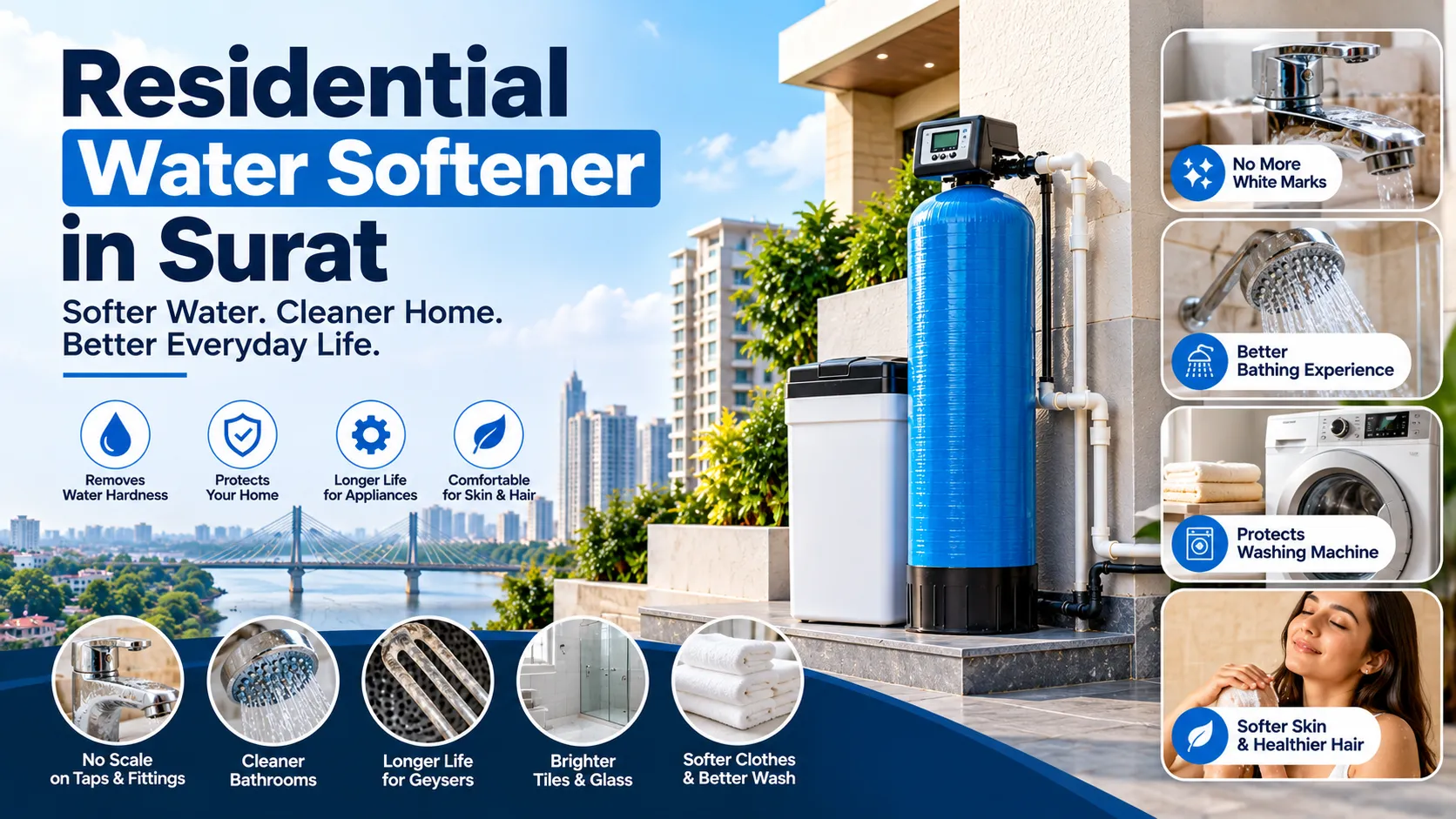
If you live in Surat and use borewell or other hard water at home, you may have noticed the same problems returning again and again: white marks around taps, scale on shower fittings, deposits on bathroom surfaces, soap that does not lather properly, and mineral buildup around water-heating equipment.
For many homeowners, the question eventually becomes simple: which residential water softener in Surat is right for my home?
The answer depends on much more than the size of the house. Water hardness, daily consumption, number of bathrooms, flow requirement, family size and the way water is used throughout the home all matter when selecting a residential water softener.
This guide explains what homeowners should know before choosing a residential water softener in Surat, how hard water affects everyday life, and how to select a suitable water softening system without simply choosing the biggest or cheapest option.
What Is a Residential Water Softener?
A residential water softener is a water treatment system designed primarily to reduce hardness-causing minerals such as calcium and magnesium from water.
Hard water is common in many groundwater sources because water can pick up naturally occurring minerals as it moves through soil and rock formations.
When this water enters a home, hardness can become noticeable through scale, deposits and changes in how soap behaves.
A properly selected home water softener can help address hardness before the water is supplied to the household outlets where soft water is required.
Why Do Homes in Surat Consider a Water Softener?
Water quality can vary from one property to another. A home using municipal water may have a different water profile from a property using borewell water, and even two borewells in different areas can produce different results.
That is why homeowners should avoid assuming that every house in Surat has the same hardness level.
Instead, the right approach is to understand the actual water quality and then choose a treatment system according to the property's needs.
For homeowners experiencing repeated scale and mineral deposits, a residential water softener in Surat can be considered when hardness is confirmed as an important part of the problem.
Common Signs That Your Home May Have Hard Water
Hard water does not always announce itself with an obvious problem. Often, the signs become visible slowly over months or years.
- White marks around bathroom taps
- Mineral deposits on shower fittings
- White spots on bathroom glass
- Scale on faucets and plumbing fixtures
- Soap and shampoo producing less lather
- Mineral buildup around geyser components
- Frequent cleaning of bathroom fittings
- Scale inside water-contact equipment
- Rough or dry feeling after bathing
- Recurring deposits even after cleaning
One symptom alone does not confirm hard water. However, when several of these problems occur together, testing the water can help identify whether hardness is contributing to the issue.
How Does Hard Water Affect Everyday Life?
The effects of hard water are often more noticeable in the bathroom and kitchen because these areas have frequent contact with water.
A family may spend considerable time cleaning taps, showerheads, tiles and glass because mineral deposits keep returning. Over the long term, this can become an unnecessary part of the household cleaning routine.
Hard water can also contribute to scale formation on equipment that regularly heats or handles water. The exact effect depends on the equipment, operating conditions and water chemistry.
This is why choosing a suitable water softening system for home can be a practical consideration when water hardness is confirmed.
Residential Water Softener vs RO: Are They the Same?
No. A residential water softener and an RO system perform different treatment functions.
| Feature | Residential Water Softener | RO System |
|---|---|---|
| Main purpose | Reduce hardness-causing minerals | Reduce many dissolved substances through membrane filtration |
| Typical application | Residential water softening | Specific treated-water requirements |
| Whole-home hardness control | Common application | Not normally the first choice for this purpose |
| Hard water scale | Can address hardness when correctly sized | Not primarily designed as a whole-house softening system |
A water softener should not be purchased simply because the TDS number looks high. TDS and hardness are different measurements, and a proper water test can provide a better basis for selecting the right treatment.
How to Choose a Residential Water Softener in Surat
Choosing a residential water softener in Surat starts with understanding the home rather than starting with a product catalogue.
Consider these factors before making a decision:
1. Water Hardness
The first consideration is the actual hardness level of the incoming water.
A laboratory or appropriate water-quality test can help determine the hardness and provide useful information for sizing the softener.
2. Number of People in the Home
A two-person household and a large family can have very different daily water consumption.
The number of residents helps estimate the amount of water that needs to be treated over time.
3. Number of Bathrooms
The number of bathrooms and simultaneous water usage can influence the required flow rate.
A large bungalow with several bathrooms may require a different solution from a compact apartment.
4. Peak Water Demand
Daily consumption is important, but peak demand also matters. If multiple showers, taps or other outlets are used at the same time, the softener needs to accommodate the required flow.
5. Installation Space
The available space near the water inlet, plumbing arrangement and drainage connection should be considered before selecting a system.
6. Regeneration Requirements
Many ion-exchange softeners use a salt-based regeneration process. Salt consumption, regeneration frequency and operating requirements should therefore be understood before installation.
What Type of Home Can Use a Residential Water Softener?
A residential water softener can be considered for different types of properties, including:
- Apartments
- Bungalows
- Villas
- Independent houses
- Large residential properties
- Newly constructed homes
The important point is that the system should be selected according to the property's water demand and water quality rather than simply its category.
Residential Water Softener for a Bungalow in Surat
Bungalows often have multiple bathrooms, larger water storage arrangements and higher peak demand than smaller homes.
For this reason, a water softener for bungalow should be sized according to actual household requirements.
For example, a family living in a four-bedroom property may have different water requirements from a smaller household even if both properties have the same number of floors.
Before installation, consider:
- Number of residents
- Number of bathrooms
- Water storage capacity
- Borewell or municipal water source
- Water hardness
- Peak flow requirement
- Available installation area
Springwell Residential Water Softener Range
Springwell Water Tech provides automatic domestic water softening systems for different residential flow requirements.
The current SWS range includes:
| Model | Flow Capacity |
|---|---|
| SWS 20 | 2000 LPH |
| SWS 25 | 2500 LPH |
| SWS 30 | 3000 LPH |
| SWS 45 | 4500 LPH |
| SWS 60 | 6000 LPH |
These capacities provide options for different residential requirements. The appropriate model should be selected after considering water hardness, household consumption and required flow.
Explore Springwell Residential Water Softener Solutions
Why Water Testing Matters Before Buying a Softener
One of the most important steps when looking for a residential water softener in Surat is water testing.
A TDS meter can provide a quick reading, but TDS alone does not tell you the complete hardness condition of the water.
Depending on the source and intended use, a water-quality assessment may consider:
- Total hardness
- TDS
- pH
- Iron
- Chloride
- Other relevant water-quality parameters
Once the water condition is understood, the softener can be selected more logically.
What Is the Difference Between TDS and Hardness?
TDS stands for total dissolved solids and represents the total amount of dissolved material measured by the selected testing method.
Hardness, however, specifically relates mainly to calcium and magnesium ions in water.
This distinction is important because a water softener is designed primarily for hardness reduction, not as a general-purpose TDS removal system.
If your home has high hardness as well as other water-quality concerns, more than one treatment stage may be appropriate depending on the test results.
How a Residential Water Softener Works
A conventional ion-exchange water softener contains resin media that interacts with hardness-causing ions as water passes through the system.
The resin gradually becomes loaded with hardness ions. A regeneration cycle then restores the resin's softening capacity using a salt solution.
This means homeowners should understand not only the initial installation but also the ongoing requirements of the system.
Salt consumption, regeneration frequency, water usage and routine maintenance can all form part of the long-term operating experience.
Can a Water Softener Help With Bathroom Scale?
When hardness is responsible for mineral deposits, reducing hardness can help reduce the conditions that contribute to scale formation.
Homeowners commonly notice deposits around:
- Bathroom taps
- Showerheads
- Faucets
- Glass shower panels
- Geyser components
- Other water-contact surfaces
Existing scale still needs to be cleaned. A softener is a water-treatment solution, not a chemical cleaner for deposits that have already formed.
Does Hard Water Affect Geysers and Appliances?
Hard water can contribute to mineral scale on water-heating components and other surfaces that remain in contact with water.
The impact varies according to the appliance, operating conditions, water chemistry and maintenance.
For a home with significant hardness and regular hot-water use, water softening can therefore be considered as part of a broader household water-treatment strategy.
Explore Springwell Hot Water Solutions
Residential Water Softener Price in Surat
The price of a residential water softener in Surat depends on the system capacity and installation requirements.
Important factors can include:
- Required flow capacity
- Water hardness
- Resin quantity
- Control valve
- Automation level
- Installation requirements
- Plumbing modifications
- Regeneration arrangement
This is why comparing only the purchase price can sometimes give an incomplete picture.
A properly sized system should balance the initial investment with practical operation and maintenance over its useful life.
Common Mistakes Homeowners Make
Buying Only Based on TDS
A TDS reading does not provide a complete picture of water hardness. Check the relevant water-quality parameters before selecting a softener.
Choosing the Biggest Model
Bigger is not automatically better. The system should match the actual water demand and hardness condition.
Ignoring Peak Flow
A system should be considered not only for daily consumption but also for periods when multiple outlets may operate at the same time.
Ignoring Regeneration Requirements
Homeowners should understand salt usage, regeneration frequency and maintenance before purchasing a water softener.
Installing Without Considering Plumbing
The location of the inlet, outlet, drain and available service space should be considered before installation.
Residential Water Softener for New Homes in Surat
If you are constructing a new home, it can be easier to plan water treatment before the plumbing is finalized.
During the planning stage, homeowners can consider where the water softener will be installed, how the treated-water line will be routed and where regeneration drainage will be provided.
Planning early can make installation and future maintenance more convenient.
Residential Water Softener for Borewell Water
If your home depends on a borewell, start by testing the water rather than assuming the hardness level.
A borewell water softener can be considered when testing confirms that hardness is an important water-quality concern.
The right system depends on:
- Borewell water hardness
- Daily household consumption
- Peak flow requirement
- Number of bathrooms
- Number of residents
- Other water-quality parameters
This approach provides a more reliable basis for selecting a residential water softener in Surat.
Why Local Water Treatment Experience Matters
Water treatment is not simply about choosing equipment from a catalogue. The source water, plumbing arrangement, property size and household usage all influence the final setup.
Working with a local water-treatment company can make it easier to discuss the water source, installation conditions and ongoing requirements.
Springwell Water Tech works with residential and commercial water-treatment requirements in Surat and South Gujarat.
View Water Softening Solutions
Frequently Asked Questions
What is the best residential water softener in Surat?
There is no single model that is best for every home. The appropriate residential water softener depends on water hardness, household consumption, peak flow, number of bathrooms and installation conditions.
Is a residential water softener suitable for borewell water?
It can be suitable when borewell water has significant hardness. Water testing should be carried out first so that the treatment system can be selected according to the actual water condition.
Does a water softener remove TDS?
A water softener is primarily designed to reduce hardness-causing calcium and magnesium. It should not be considered a general-purpose TDS removal system.
How do I choose a water softener for my bungalow?
Consider the number of residents, bathrooms, daily water consumption, peak flow, water hardness and available installation space. These factors help determine the appropriate capacity.
How often does a residential water softener regenerate?
Regeneration frequency depends on water hardness, water consumption, resin capacity and the control settings of the system. It should be determined according to the actual operating conditions.
Can a water softener prevent bathroom scale?
When hardness is the main cause of mineral scale, reducing hardness can help reduce the conditions that contribute to new scale formation. Existing deposits still require cleaning.
Should I install a water softener before or after my RO?
The correct arrangement depends on the water-quality conditions and the intended treatment process. A water-treatment professional can determine the appropriate configuration after reviewing the water test.
Final Thoughts
Finding the right residential water softener in Surat is less about buying the largest system and more about understanding your home's actual water requirements.
Start with a water test. Check hardness, understand your daily consumption, consider peak flow and then choose a properly sized water softening system.
For apartments, bungalows, villas and independent houses, a properly selected residential water softener can become an important part of a practical home water-treatment setup.
If you are dealing with hard borewell water, recurring scale or mineral deposits in your home, Springwell Water Tech can help you evaluate your requirements and identify a suitable water-softening approach.
Looking for a Residential Water Softener in Surat?
Have your water tested and share the report with Springwell Water Tech. Our team can help you understand the water condition and select a suitable residential water softening solution based on your home's requirements.
Vimal Sutariya
Vimal Sutariya has over 12 years of hands-on field experience designing and installing water softening plants, commercial RO systems, and booster pumps across Surat, Hazira, Sachin GIDC, and South Gujarat.
Planning a Commercial RO System for Your Business?
Discuss your water quality, daily demand, and application requirements with Springwell Water Tech to identify a suitable water treatment solution tailored to your facility.
Related Water Treatment Guides
View all articles
Borewell Water Hardness Solution in Surat: A Practical Guide for Homes (2026)
A practical guide to understanding borewell water hardness in Surat and choosing the right water softening solution for homes, bungalows and residential properties.
Best Water Softener in Surat: A Practical Buyer's Guide for 2026
A practical guide to choosing the right water softener for apartments, villas and bungalows in Surat, including sizing, hardness testing, automatic regeneration, maintenance and installation.