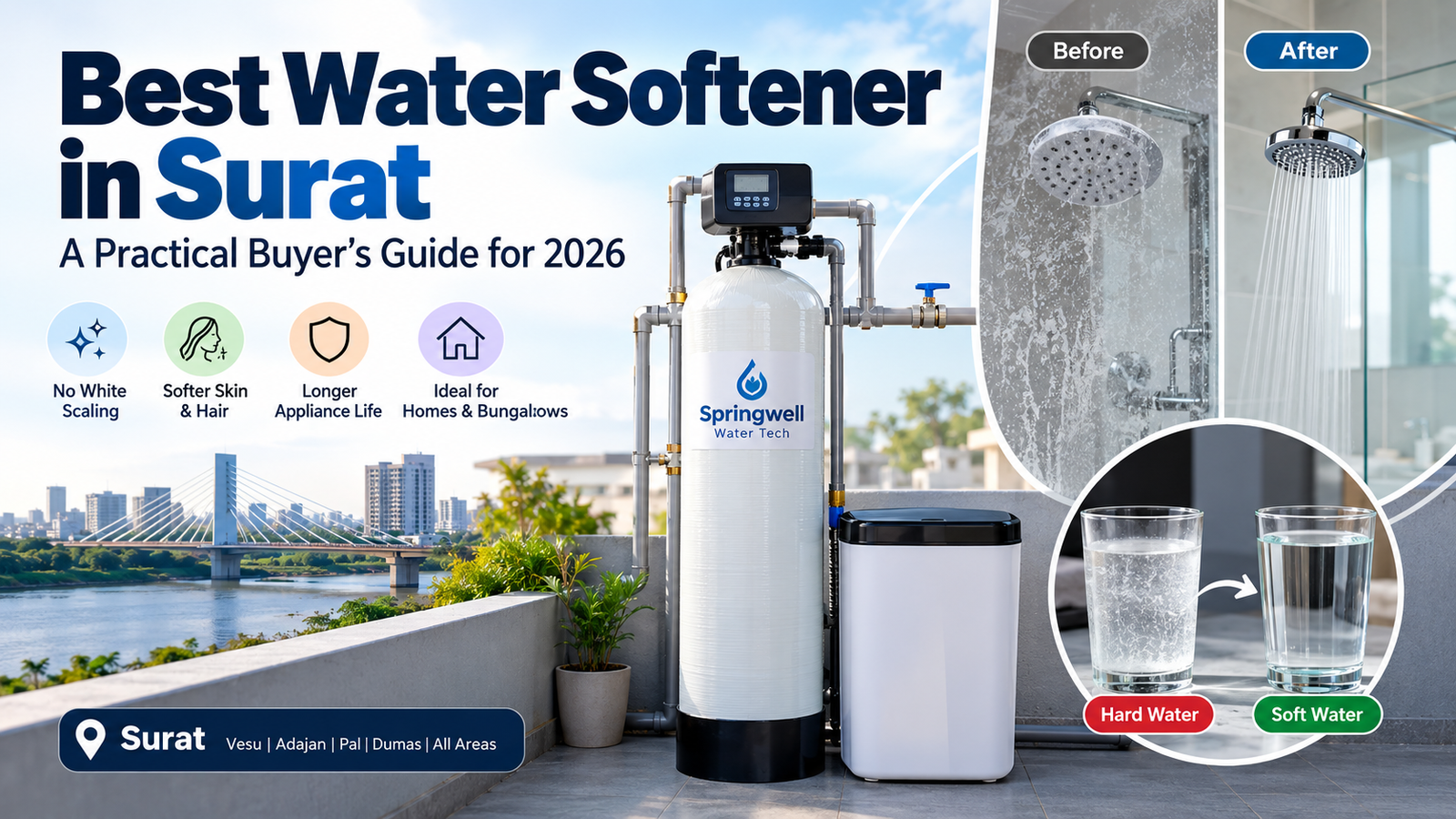
Best Water Softener in Surat: A Practical Buyer's Guide for 2026
A practical guide to choosing the right water softener for apartments, villas and bungalows in Surat, including sizing, hardness testing, automatic regeneration, maintenance and installation.

Quick Answer: What Is the Best Water Softener in Surat?
The best water softener for a home in Surat is not necessarily the biggest, most expensive or most heavily advertised system. It should be correctly sized for your home's water hardness, daily water usage, number of bathrooms and peak flow requirement.
For many homes, an automatic resin-based water softener can be a practical way to reduce hardness-related scale in bathrooms, plumbing and water-using appliances. The important part is choosing the right capacity and setting up the system correctly.
Best Water Softener in Surat: A Practical Buyer's Guide for 2026
If you have ever cleaned white deposits from a tap, showerhead or bathroom glass, you already know how frustrating hard water can be.
A new apartment or bungalow may look perfect when you move in. The bathroom fittings are clean, the shower works smoothly and the tiles look fresh. After some time, however, mineral deposits can start appearing around taps, showerheads, glass panels and other surfaces.
This is one reason homeowners in Surat consider installing a whole-house water softener. But choosing one is not as simple as searching for a brand and buying the first model you find.
A softener that works well for a compact apartment may not be suitable for a large bungalow with several bathrooms, rain showers and higher water consumption.
In this guide, we will look at what actually matters when choosing a water softener in Surat, how automatic systems work, what you should check before buying one and how to decide the right capacity for your home.
Why Do Homes in Surat Consider a Water Softener?
Water hardness is mainly associated with dissolved calcium and magnesium. When hard water is repeatedly used around the home, these minerals can leave deposits on surfaces and contribute to scale inside certain plumbing and heating equipment.
The actual water quality can vary from one property to another, so it is better to test the water rather than assume that every area or society has exactly the same hardness level.
Common Signs of Hard Water
White Deposits on Fittings
Mineral deposits can appear around taps, showerheads, glass panels and other bathroom surfaces. Regular cleaning may become more time-consuming as deposits build up.
Scale Around Heating Equipment
Hardness-related scale can accumulate inside water-heating equipment over time. The amount of buildup depends on water quality, temperature and usage.
Soap and Detergent Performance
Hard water can affect the way soap and detergents behave, which may result in greater cleaning effort for bathrooms, clothes and other household tasks.
More Bathroom Cleaning
If mineral marks keep returning after cleaning, the issue may be related to the hardness of the water being used in the property.
A useful first step: test the water before choosing a treatment system. TDS and hardness are different measurements, and both should not be treated as the same thing.
What Makes a Water Softener the "Best" Choice for Your Home?
There is no single water softener that is perfect for every property. The right system depends on the conditions of the home.
When comparing systems, these are the factors worth checking before making a purchase.
1. Automatic Regeneration
Resin-based water softeners need periodic regeneration to restore their treatment capacity. An automatic control valve can manage this process according to the system's programmed settings.
This is one reason automatic systems are often more convenient for residential use than systems that require frequent manual valve operation.
2. Correct Resin Capacity
The resin is the working part of a conventional ion-exchange softener. The required quantity depends on factors such as water hardness, household consumption and the desired regeneration schedule.
More resin is not automatically better. The system should be sized according to the actual requirement.
3. Suitable Flow Rate
A softener must be able to handle the water flow required by the property. A family using several bathrooms at the same time can have a very different peak demand from a small apartment.
4. Proper Water Testing
Before choosing a system, find out what is actually present in the water. A water test can help the installer understand the hardness level and other relevant characteristics.
5. Practical Salt Management
Automatic regeneration requires salt for the brine process. Ask the supplier how the salt is added, where the brine tank will be placed and how frequently salt may need to be replenished under your expected usage.
6. Good Installation Design
The equipment itself is only one part of the system. Proper inlet and outlet connections, drainage, bypass arrangements and installation space should all be considered.
Automatic vs Manual Water Softener: Which Is More Convenient?
Manual and automatic softeners use the same basic principle of treating hard water with ion-exchange resin, but the regeneration process is handled differently.
| Feature | Manual Softener | Automatic Softener |
|---|---|---|
| Regeneration | Requires manual operation | Managed through the control valve |
| Daily Convenience | More involvement from the homeowner | More convenient for regular residential use |
| Control | Manual valve operation | Programmable automatic control |
| Residential Suitability | Suitable where manual maintenance is acceptable | Suitable where convenience is a priority |
How to Choose the Right Water Softener Size for Your Home
One of the most common mistakes is choosing a softener simply because it is advertised as a "home water softener." Homes have different water requirements.
A useful starting point is to consider the number of people, bathrooms, daily water usage and the amount of water that may be required at peak times.
| Property Type | Typical Requirement | What to Consider |
|---|---|---|
| Apartment / 2–3 BHK | Moderate household consumption | Number of residents, bathrooms and available installation space |
| 3–4 BHK Home | Higher daily consumption | Flow rate, hardness and simultaneous bathroom usage |
| Large Bungalow | High household and peak demand | Multiple bathrooms, rain showers, storage and peak flow |
| Luxury / High-Flow Property | High and variable water demand | Detailed sizing based on actual usage and water quality |
Important: These property categories are only a starting point. The final softener size should be selected using actual water quality and household consumption rather than bedroom count alone.
Water Softener vs RO: Which One Does Your Home Need?
This is one of the most common questions homeowners ask. A water softener and an RO system are not interchangeable.
A conventional water softener is designed primarily to reduce hardness caused by calcium and magnesium. An RO system uses a membrane process to reduce dissolved substances and is commonly used for drinking-water purification.
| Factor | Water Softener | RO System |
|---|---|---|
| Main Purpose | Reduce water hardness | Reduce dissolved substances through reverse osmosis |
| Typical Application | Whole-house water | Drinking and cooking water |
| Hardness Control | Primary purpose | Not usually the practical whole-house approach for hardness |
| Installation | Can be connected to the main household water line | Commonly installed for selected drinking-water outlets |
In Simple Terms
If your main problem is hardness and scale throughout the house, a water softener addresses a different need from the RO system in your kitchen. Depending on the incoming water quality, some homes may use both systems for different purposes.
Water Softener Price in Surat: What Affects the Cost?
Searching for water softener price in Surat can be confusing because two systems that look similar from the outside can have very different capacities and components.
The final cost can depend on the resin quantity, automatic control valve, vessel size, brine tank, flow capacity, installation requirements, water quality and the amount of plumbing work involved.
Before Comparing Prices, Check What Is Included
- Resin quantity and specification
- Automatic control valve
- Softener vessel
- Brine tank
- Inlet and outlet connections
- Drain connection for regeneration
- Bypass arrangement
- Installation and commissioning
- Warranty and service terms
Instead of choosing the cheapest quotation, compare the complete system and the service included with it. A correctly sized system with proper installation can be more useful than an inexpensive system that is undersized for the property.
What Should Be Included in a Professional Water Softener Installation?
Buying the equipment is only the first step. The installation should also be planned around the property's plumbing layout.
Main Water Connection
The softener should be connected at an appropriate point in the household water line so that the intended outlets receive softened water.
Bypass Arrangement
A bypass allows the softener to be isolated when maintenance or servicing is required.
Drain Connection
Regeneration produces wastewater, so the installation needs an appropriate drain arrangement.
Service Access
There should be enough space around the equipment for salt replenishment, inspection and future servicing.
How Much Maintenance Does a Water Softener Need?
A water softener does not mean zero maintenance. Like any water treatment equipment, it needs basic attention to continue working properly.
Routine Maintenance Usually Includes
- Checking and replenishing regeneration salt
- Inspecting the brine tank
- Checking the control valve
- Checking inlet, outlet and drain connections
- Monitoring the soft-water performance
- Periodic professional servicing when required
Salt consumption is not the same for every household. It depends on water hardness, water usage, resin capacity and the regeneration settings of the system.
How Springwell Water Tech Selects a Water Softener
At Springwell Water Tech, the goal is not simply to put a softener in the house and call the job finished. The system needs to make sense for the property's actual water requirement.
Our approach starts with understanding the water quality, household usage and installation conditions before selecting the appropriate system.
Understand the Water
We look at available water-quality information and identify the treatment requirement instead of relying only on assumptions about the location.
Size the System
Household water consumption, hardness and expected flow demand are considered when selecting the softener capacity.
Plan the Installation
The location, plumbing connections, drain arrangement, bypass and maintenance access are considered before installation.
Springwell Water Tech provides domestic and commercial water treatment solutions from Surat, including automatic water softening systems for residential applications.
Frequently Asked Questions About Water Softeners in Surat
Which water softener is best for a 3 BHK home?
The right model depends on the number of residents, bathrooms, daily water consumption, water hardness and peak flow requirement. A water test and usage assessment can help determine the appropriate capacity.
Does a water softener remove TDS?
A conventional ion-exchange water softener is designed primarily to reduce hardness. It should not be considered the same as an RO system for broad TDS reduction.
Can I drink softened water?
Softened water is not automatically the same as purified drinking water. Because treatment requirements depend on the source water and the intended use, drinking-water treatment should be evaluated separately. An RO system may be used where appropriate for drinking water.
Does a water softener remove white stains from bathroom fittings?
A softener can reduce the hardness that contributes to mineral scaling. Existing deposits may still need to be cleaned, while reducing hardness can help limit further hardness-related buildup.
How much salt does a water softener use?
Salt consumption varies according to water hardness, household water usage, resin capacity and regeneration settings. There is therefore no single salt-consumption figure that applies to every home.
How much does a water softener cost in Surat?
Pricing depends on system capacity, resin quantity, control valve, vessel, brine tank, installation requirements and other components. The best way to compare quotations is to compare the complete specification rather than looking only at the equipment price.
Can a water softener be used for an entire house?
Yes. Whole-house water softening is a common application of residential water softeners. The system should be sized according to the property's water consumption and peak flow requirement.
Looking for a Water Softener in Vesu, Adajan, Pal or Other Parts of Surat?
Water conditions can vary between buildings, societies and individual properties. That is why choosing a water softener based only on a neighbour's system or a generic online recommendation may not give you the right result.
If you are planning a new home, renovating a bungalow or dealing with recurring scale on bathroom fittings, start with the water itself. Once the hardness and household requirement are understood, selecting the appropriate softener becomes much easier.
Final Takeaway
The best water softener in Surat is the one that matches your home's actual water quality and usage rather than simply being the largest or most expensive model available.
Before buying, check the water hardness, estimate your daily consumption, consider peak flow, compare resin capacity and understand how regeneration and salt management work.
For a small apartment, the requirement may be relatively simple. For a large bungalow with multiple bathrooms, the system needs more careful planning.
In either case, a proper water assessment is a better starting point than choosing a system based only on price or a generic "best seller" label.
Vimal Sutariya
Vimal Sutariya has over 12 years of hands-on field experience designing and installing water softening plants, commercial RO systems, and booster pumps across Surat, Hazira, Sachin GIDC, and South Gujarat.
Planning a Commercial RO System for Your Business?
Discuss your water quality, daily demand, and application requirements with Springwell Water Tech to identify a suitable water treatment solution tailored to your facility.
Related Water Treatment Guides
View all articles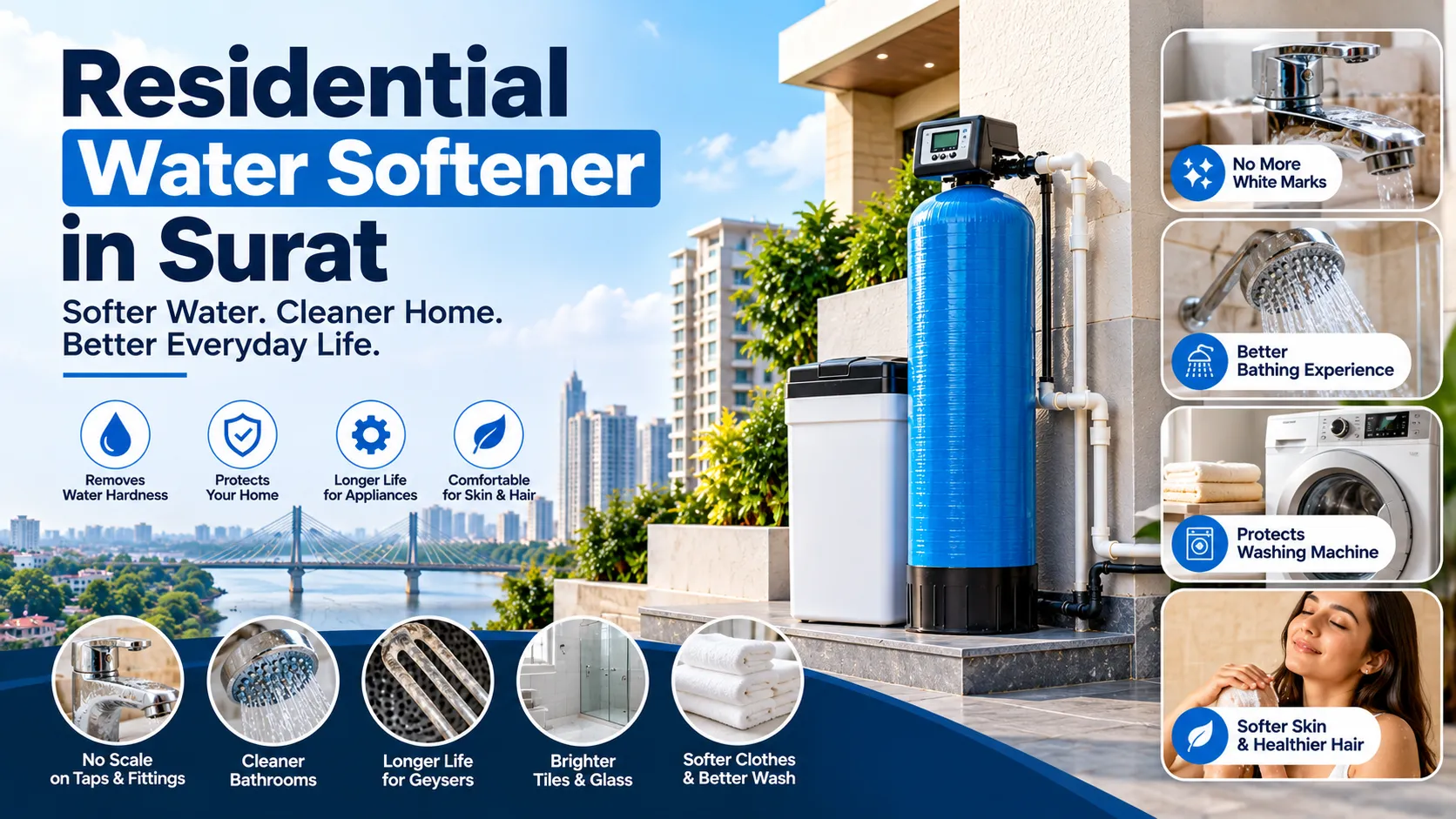
Residential Water Softener in Surat: A Practical Guide for Homes
A practical guide to choosing a residential water softener in Surat for apartments, bungalows, villas and other homes affected by hard water.
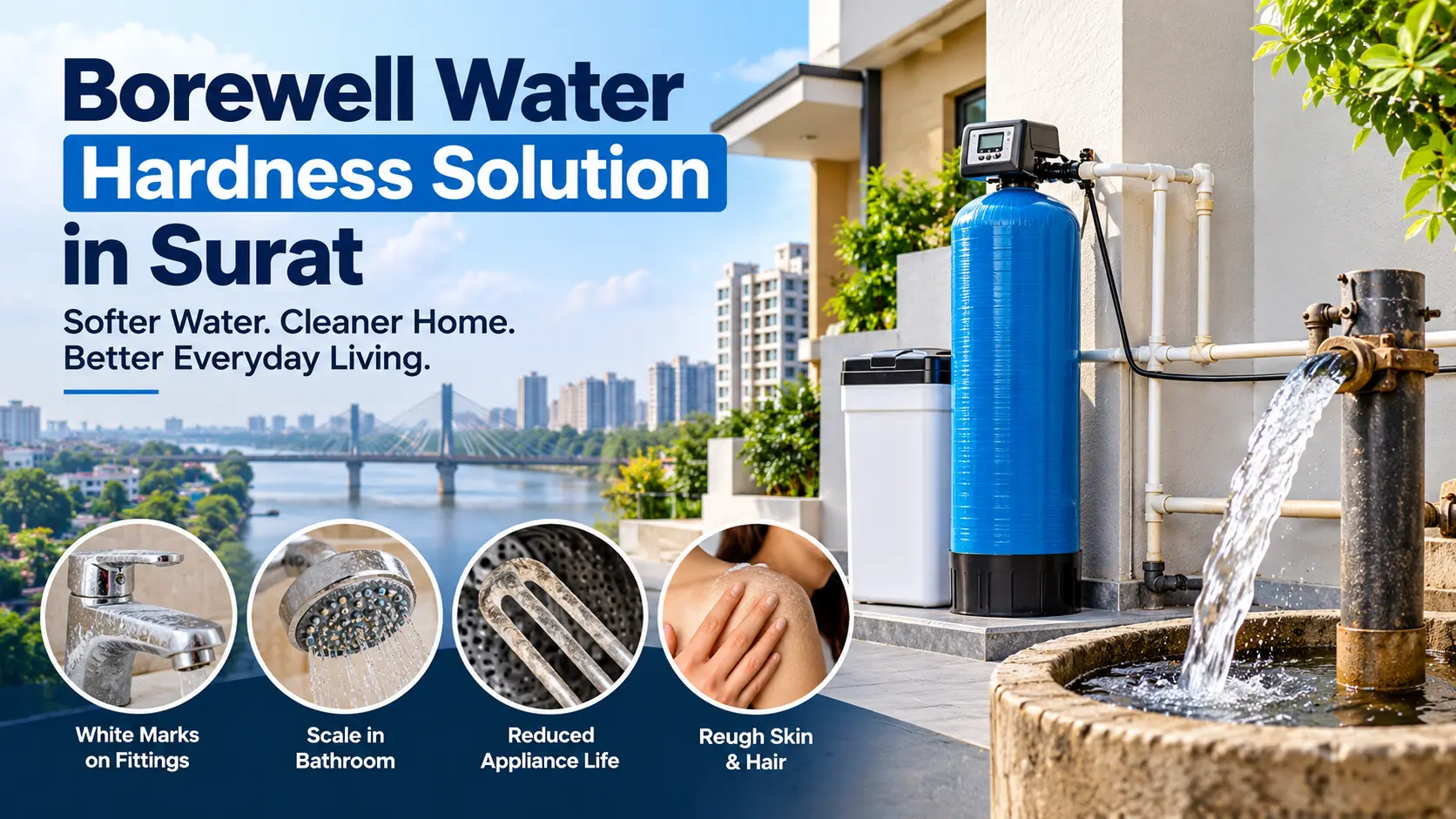
Borewell Water Hardness Solution in Surat: A Practical Guide for Homes (2026)
A practical guide to understanding borewell water hardness in Surat and choosing the right water softening solution for homes, bungalows and residential properties.