Water Softener vs RO Plant: What is the Real Difference and Which One Does Your Home Need?
Many homeowners in Surat mistakenly install an RO purifier when they actually need a whole-house water softener. Here is the complete engineering breakdown of hardness vs TDS.

The Common Homeowner Confusion in Surat
Almost every week during on-site water inspections in areas like Vesu, Adajan, and Pal, we meet homeowners who ask us: "We already have an RO system in our kitchen, so why are our bathroom tiles turning white and why is our geyser element failing?"
The answer lies in understanding that a water softener and a Reverse Osmosis (RO) plant do two completely different jobs. One protects your entire house, while the other purifies small quantities of drinking water.
Quick Comparison: Softener vs Reverse Osmosis (RO)
| Feature | Automatic Water Softener | Reverse Osmosis (RO) System |
|---|---|---|
| Primary Purpose | Removes Calcium & Magnesium hardness ions (Anti-scaling) | Reduces Total Dissolved Solids (TDS), bacteria, chemicals & heavy metals |
| Water Treated | Whole house / utility water (Bathrooms, kitchen, geysers, washing machine) | Drinking & cooking water only (Point-of-use) |
| Technology Used | Strong Acid Cation (SAC) Ion-Exchange Resin | Semi-permeable Polyamide Thin-Film Composite (TFC) Membrane |
| Effect on Water TDS | TDS remains almost the same (Calcium swapped for Sodium) | Reduces TDS by 90%–95% (e.g., from 1200 ppm to <100 ppm) |
| Water Wastage | Minimal (~2% to 4% during automatic brine backwash) | 35% to 50% reject water (unless commercial energy recovery used) |
| Scale Prevention | 100% eliminates scale on taps, tiles & geysers | Prevents scale only inside drinking water vessels |
How an Automatic Water Softener Works
Water hardness is caused by dissolved Calcium (Ca2+) and Magnesium (Mg2+) minerals in your borewell or tanker supply. When heated in geysers or exposed to air on chrome taps, these minerals crystallize into chalky white limescale (calcium carbonate).
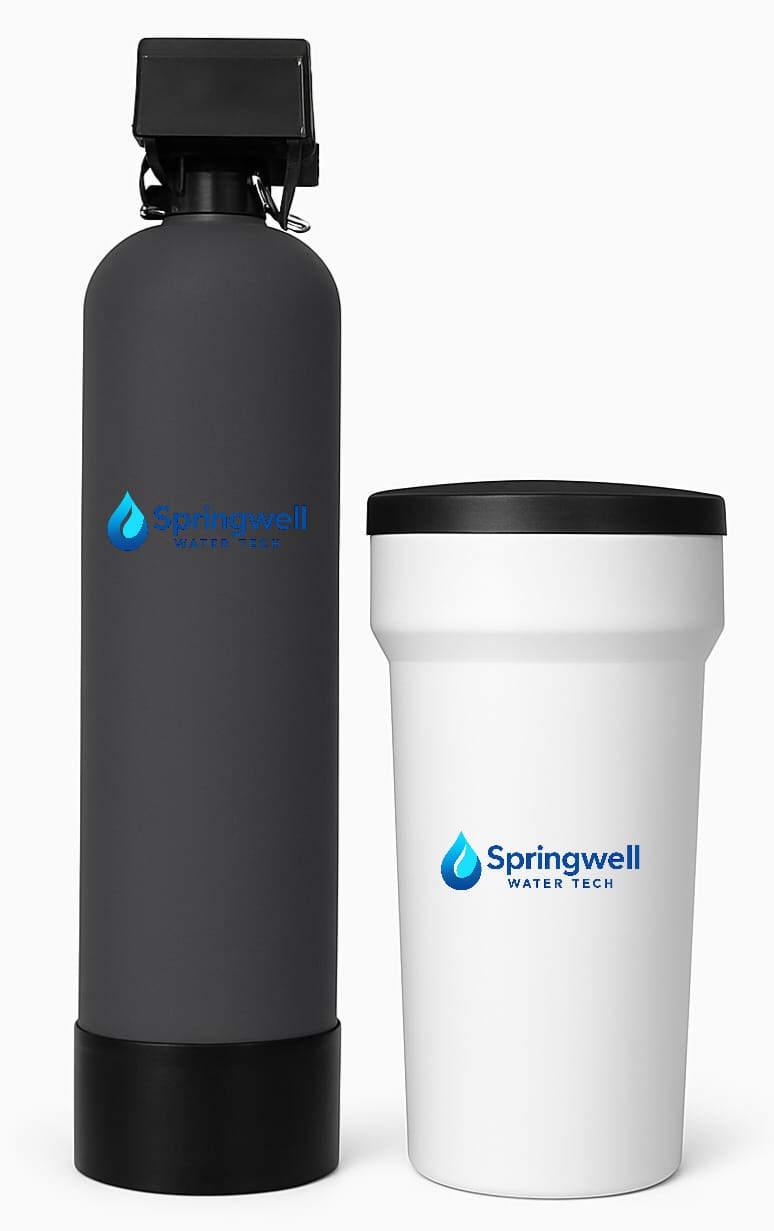
A Springwell SWS Series Automatic Water Softener passes incoming raw water through a pressure vessel filled with food-grade ion-exchange resin. The resin holds sodium ions (Na+) that swap places with the calcium and magnesium. Once the resin is saturated, the digital automatic valve rinses the bed with simple table salt brine solution (NaCl), flushing the captured hardness down the drain.
When Do You Need a Water Softener?
- White salt marks: Chalky white patches on premium Jaquar, Kohler, or Grohe bathroom fittings.
- Frequent geyser failures: Electric geyser heating coils burning out every 12 to 18 months due to scale insulation.
- Low shower flow: Rain shower nozzles getting clogged with hard white crust.
- Hair fall and rough skin: Inability to form rich soap lather during bathing.
- Washing machine damage: Stiff laundry and mineral deposits on drum heating coils.
When Do You Need an RO Plant?
An RO plant is required when your raw water has high salinity, high TDS (>500 ppm), heavy metals, or chemical impurities that make the water unsafe for human consumption or specific industrial processes.
For commercial establishments (hotels, hospitals, industrial factories, and textile processing units in Hazira and Sachin GIDC), a Commercial RO Plant (100–10,000 LPH) is installed to bring water TDS down to drinking and processing standards.
Can You Use Both Together?
Yes! In fact, that is the ideal engineering setup:
- An Automatic Water Softener is installed at the main terrace/underground line to protect all bathrooms, plumbing pipes, heat pumps, and geysers.
- A small Kitchen RO unit receives the already softened water, which actually protects the expensive RO membrane from premature calcium fouling!
Need On-Site Water Testing in Surat?
Our engineers carry digital TDS meters and chemical hardness titration kits to test your water parameters at your doorstep in Surat, Navsari, or Vapi.
Book Free On-Site Water TestVimal Sutariya
Vimal Sutariya has over 12 years of hands-on field experience designing and installing water softening plants, commercial RO systems, and booster pumps across Surat, Hazira, Sachin GIDC, and South Gujarat.
Facing Hard Water or High TDS in Surat?
Get your home or commercial water tested by our experienced technicians. We test Total Dissolved Solids (TDS), Calcium Hardness, and Turbidity right at your doorstep.
Related Water Treatment Guides
Surat Water Hardness Guide: Borewell TDS & Hardness Levels Across Vesu, Adajan, Pal & Hazira
Surat groundwater varies drastically between coastal zones, riverbeds, and industrial corridors. Here is our field data on water parameters across major Surat localities.
Heat Pumps & HeatingHeat Pump vs Electric Storage Geyser: Annual Electricity Bill Comparison for Gujarat Homes
For 3 BHK and 4 BHK bungalows with multiple bathrooms, running separate electric geysers consumes huge amounts of power. Here is the real mathematical ROI of central heat pumps.